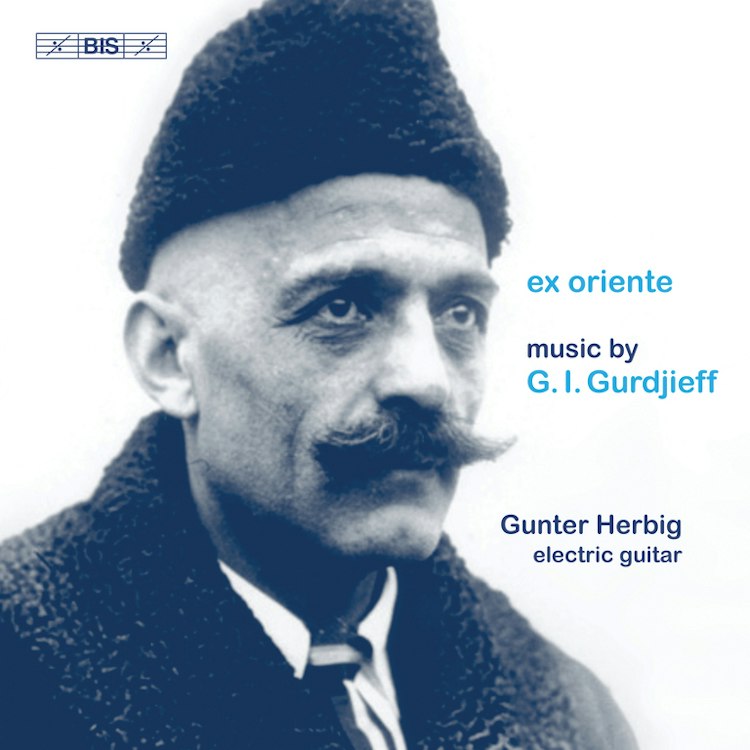
The performer, Gunter Herbig, initially struggled to transcribe Gurdjieff's piano music for classical guitar but found success when he switched to an electric Gretsch 'White Falcon' guitar and Fender amp.
Composer Biography
As a young man, Gurdjieff traveled extensively through the East, including Tibet, Afghanistan, and Central Asia, seeking answers to spiritual questions and absorbing music from various cultures.
Cultural Impact
Gurdjieff established the 'Institute for the Harmonious Development of Man' at Château Le Prieuré near Paris, attracting students globally, including New Zealand writer Katherine Mansfield.
Compositional Technique
Thomas de Hartmann faced challenges transcribing Gurdjieff's Eastern melodies, which lacked conventional Western meters and tuning, requiring him to capture complex rhythms and subtle tonalities.
Composer's Artistic Vision
Gurdjieff's teachings emphasized that 'without struggle, no progress and no result,' and that 'every breaking of habit produces a change in the machine.'
Composer Biography
G. I. Gurdjieff, whose music is featured on this album, was born in Alexandropol, a cultural melting pot on the border of Russian Armenia and Turkey, to a Greek bard and an Armenian mother.
Composition History
The music on this album is the result of a unique collaboration between Gurdjieff and Thomas de Hartmann, a successful Russian composer and pianist, who transcribed Gurdjieff's melodies into over 300 piano pieces.
You might also enjoy...
John White: Piano Sonatas
Paganimania
Orfeo amoroso
Piano Music - Sigurbjornsson, T. / Ingolfsson, A. / Tomasson, H. / Sveinsson, A. / Urbancic, V. / Vidar, J. / Hallgrimsson, H.