Charles Martin Loeffler, the composer of the Octet, was born in Berlin but concealed his German heritage, falsely claiming Alsatian origin for most of his life.
Critical Reception
Despite his current obscurity, Charles Martin Loeffler was hailed as 'the dean of American composers' in his obituaries and was one of the most performed American composers in the early 20th century.
Composer's Artistic Vision
Loeffler's Octet embraces a host of eclectic musical resonances, straddling influences from Brahms to Debussy to early Schoenberg, with moods ranging from elegiac Wagnerian to a folksy alla Zingara finale.
Compositional Technique
Loeffler's Octet for two clarinets, harp, string quartet, and double bass, resembles Maurice Ravel's unique blend of winds, strings, and harp in his Introduction and Allegro.
Recording & Production
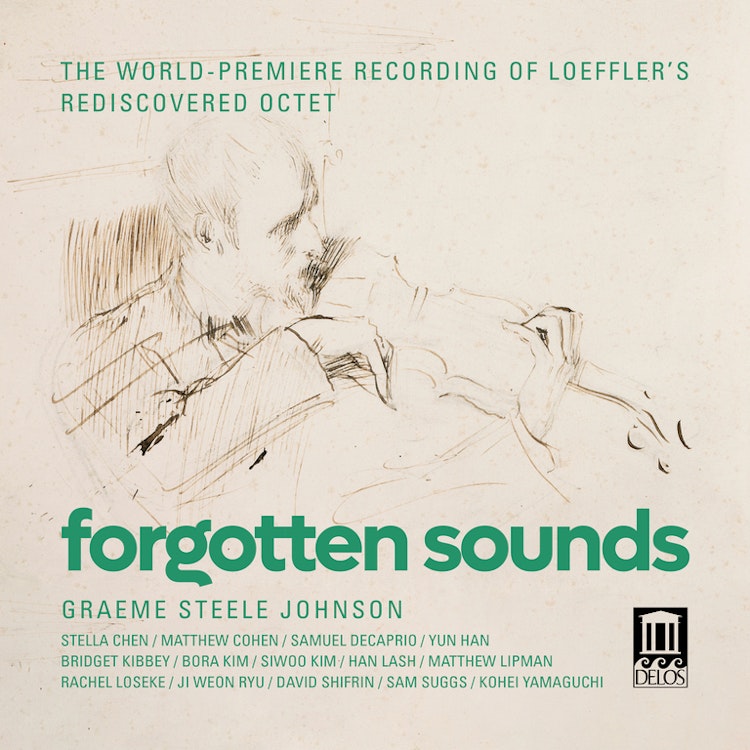
This album features the world-premiere recording of Charles Martin Loeffler's Octet, over 125 years after it was written.
Composition History
Loeffler's Octet, composed in 1897, was left unpublished, unrecorded, and unheard since its two initial performances in 1897 until this recording.
Album & Artwork
The album closes with another little-known Loeffler work, Timbres oubliés (Forgotten Sounds), originally for voice and piano, heard here for the first time on clarinet and harp.
You might also enjoy...
Dialogues
Retrospective II - Rarities
Viola & Organ
SKIES
Arne Oldberg: The Composer at the Piano - An Archival Collection of Solo Piano & Chamber Works by Arne Oldberg (1874-1962)
Weckmann: Conjuratio
Goetz: Piano Quartet in E Major, Op. 6 & Piano Quintet in C Minor, Op. 16
Fermata
Sgambati: Complete Piano Music, Vol. 1
Ritual Pictures
Bach: Stil'antico Motets
Wind Quintet Arrangements - Mozart, W.A. / Gershwin, G. / Bach, J.S. / Stravinsky, I. / Macdowell, E. / Rimsky-Korsakov, N.A.