In his opening letter, Frescobaldi explains that his principal aim was to help organists improvise freely around the opening Kyrie chants.
Composition History
Fiori Musicali, written in 1635 by Girolamo Frescobaldi, was his last work and a significant celebration of his musical genius.
Historical Context
The history of the Organ Mass, where choir and organ alternate, dates back to around the early 15th century, with elements evolving from the Codex Faenza manuscript.
Composer Biography
Girolamo Frescobaldi, the composer, was an organist at St Peter's, Rome, and his influence and fame spread throughout Europe.
Album & Artwork
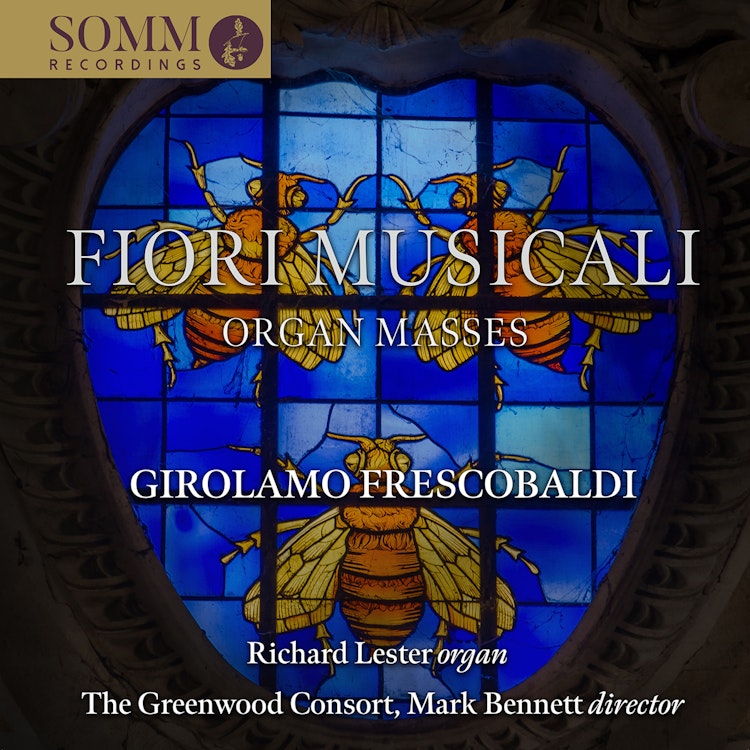
The album's cover image features the Barberini bees, Pope Urban VIII's coat of arms, which is also shown on the original frontispiece of Fiori Musicali, dedicated to the Barberini family.
Compositional Technique
Frescobaldi's Fiori musicali is unusual because, although the Kyries are present, the Gloria, Sanctus, and Agnus Dei are completely omitted from each of the three masses.
Compositional Technique
The Fiori Musicali includes pieces with secular themes, such as 'La Bergamasca' and 'Capriccio sopra la Girolmeta', which were considered disrespectful in a religious context.
You might also enjoy...
Francisco Correa de Arauxo: Tientos & Canciones
Joseph Rheinberger: Organ Pieces, Vol. 3
Muffat: Complete Apparatus Musico-Organisticus
Jehan Titelouze: Hymnes de l'église
Bach: Das Orgelbüchlein
De Torres: Complete Organ Music
J.S. Bach: Orgelbüchlein, BWV 599-644
Widor: Complete Organ Symphonies Vol. 1: Gothique & "Romane"
Cabezón: Complete Keyboard Works, Vol. 4
Bach, J.S.: Organ Music, Vol. 7 - Orgelbuchlein (Das)
Bach, J.S.: Organ Works, Vol. 3 - Orgelbuchlein, Part 1
Bariolla: Ricercate for Organ
Speth: Ars Magna Consoni et Dissoni, Music for Organ