In 1697, Augustus the Strong, the reigning prince of Protestant Saxony, converted to Catholicism for political reasons, which led to the establishment of Catholic court services in Dresden.
Composer Biography
Hasse served as court Kapellmeister in Dresden from 1733 to 1763 and was also "maestro di cappella" at the Ospedale degli Incurabili, an orphanage for girls in Venice, from at least 1736.
Compositional Technique
Hasse's personal style combines virtuosity with elegance in vocal lines, features "pre-classical" harmony rich in chromaticism and seventh chords, and uses expressive, contrasting instrumentation.
Composer Biography
Johann Adolf Hasse, born in 1699, lived "between the epochs," being younger than Bach and Handel but older than Haydn and Mozart, and was one of the formative composers of his time.
Composition History
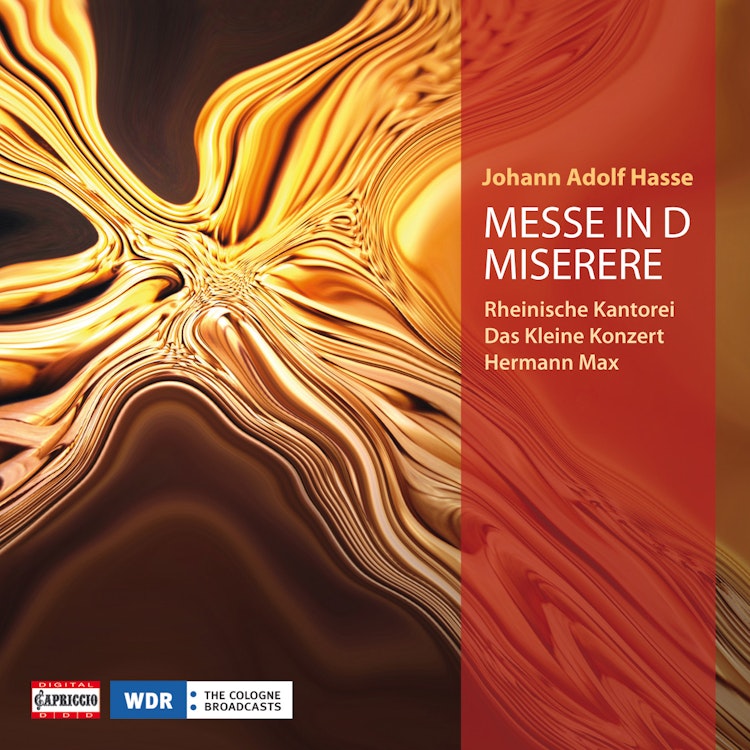
Hasse's Mass in D minor and a Te Deum by him were performed on June 29, 1751, at the consecration of the new court chapel in Dresden, designed by Gaetano Chiaveri.
Compositional Technique
Hasse's Mass in D minor is a "number Mass" typical of its time, subdividing the five sections of the Mass Ordinary into fifteen smaller, musically independent movements.
Compositional Technique
Hasse's Miserere in C minor exists in multiple authentic versions, as he often adapted his works to different local circumstances, including a version for female voices and a later one for mixed choir.
You might also enjoy...
Kodály: Budavari Te Deum / Missa Brevis
Verdi und Puccini
Menotti : Missa O Pulchritudo / Vierne: Messe Solennelle
Saint-Saens, C.: Oratorio De Noel / Mass, Op. 4
Szymanowski: Stabat Mater - Litania - Demeter
Herzogenberg: Totenfeier & Requiem
Stravinsky: Symphony of Psalms / Boulanger, L.: Psalms
Dvorak: Complete Sacred Choral Music
Robert Schumann: Der Rose Pilgerfahrt & Requiem
Biber: Requiem a 15 & Vesperae a 32
Fauré : Requiem, Messe basse & Cantique de Jean Racine
Bruch, M.: Weihnachts Musik (Christmas Music)
Gounod, C.-F.: Messe Breve No. 7 Aux Chapelles / Mass in B-Flat Major / Mass No. 2 / Ave Maria