Despite initial success, a planned repeat performance of Il ritorno di Tobia in 1781 failed because public taste had changed and the work, taking almost three hours, was considered too long.
Composition History
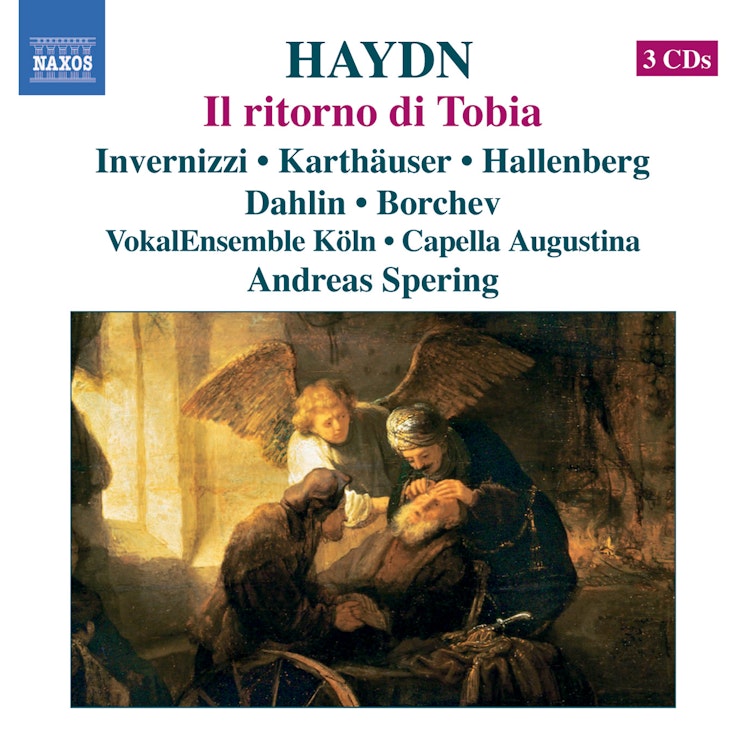
Haydn's oratorio Il ritorno di Tobia was written for the Vienna Tonkünstler-Societät and premiered in 1775 at benefit concerts for the upkeep of their widows and orphans.
Recording & Production
This recording of Il ritorno di Tobia by Andreas Spering primarily follows the 1775 'original version' but integrates two magnificent choruses, "Ah gran Dio!" and "Svanisce in un momento," written for a 1784 repeat performance.
Composition History
The libretto for Il ritorno di Tobia was written by Giovanni Gastone Boccherini, brother of the famous cellist-composer Luigi Boccherini, and reduced the extensive biblical story to focus on Tobias's return and the curing of his father.
Compositional Technique
Haydn's Il ritorno di Tobia uses a standard alternation of recitative and aria for soloists, with choruses appearing as structural pillars at key points, and features wide-ranging, virtuosic arias that are still demanding for soloists today.
Historical Context
Haydn tailored Il ritorno di Tobia to Viennese taste, which at the time preferred Italian oratorios, even for works originally in English or German.
Critical Reception
At its 1775 premiere, the Viennese Realzeitung reported that Haydn's Il ritorno di Tobia combined 'Expression, Nature and Art' so skillfully that the audience was delighted, comparing his choruses to Handel's.
You might also enjoy...
Scarlatti: Il trionfo della Grazia
Feo: San Francesco di Sales
Haydn, J.: Schopfung (Die) (The Creation)
Sacchini: L'abbandono delle richezze di S. Filippo Neri (D. Hauk, F. Hauk & M. Hößl Critical Edition)
Tommaso Traetta: Rex Salomon
Sir Neville Marriner Plays Handel
Telemann: Gelobet sei der Herr, TWV 1:602/1216 & Bequemliches Leben, gemächlicher Stand, TWV 1:123
Alessandro Scarlatti Collection, Vol. 3
Anniversary Series, Vol. 5: The Most Beautiful Concert Highlights from Maulbronn Monastery, 2002 (Live)
Lusitano Impero: Hidden Gems of the Portuguese Baroque