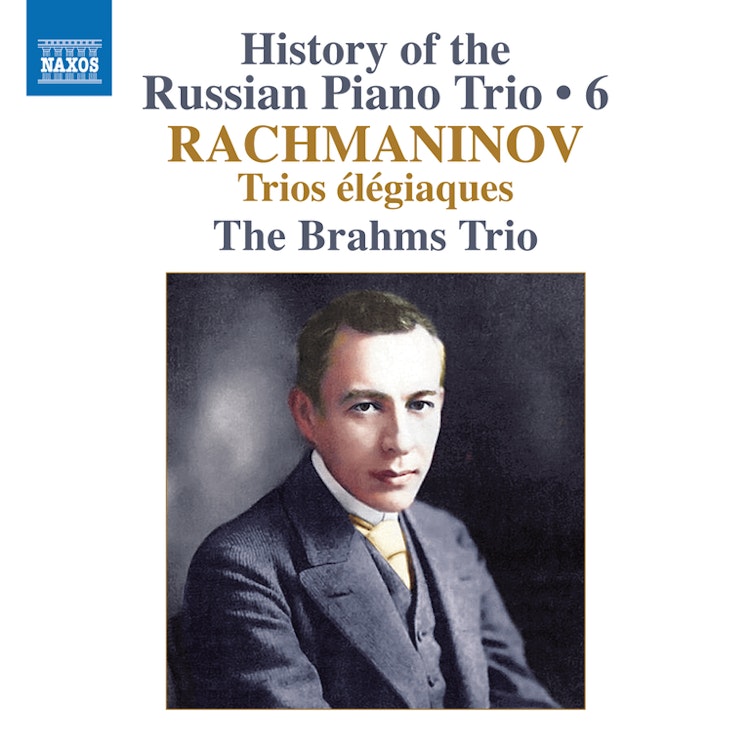
Rachmaninov began composing his Trio élégiaque No. 2 in D minor on the same day he received news of Tchaikovsky's sudden death in October 1893.
Album & Artwork
This album is the second part of a series titled 'History of the Russian Piano Trio', focusing on the Silver Age and Art Nouveau period.
Compositional Technique
Rachmaninov's Trio élégiaque No. 1 in G minor uses a mirrored inversion of the opening motif from Tchaikovsky's First Piano Concerto as its main theme.
Composer Biography
Rachmaninov's life was divided by the Russian Revolution, and his early works already show premonitions of future partings, long before his forced emigration in 1918.
Performer Biography
The Brahms Trio, a leading Russian chamber ensemble, has made an invaluable contribution to expanding the chamber repertoire by rediscovering unknown piano trios by Russian composers.
Compositional Technique
The original score of Rachmaninov's Trio élégiaque No. 2 included a harmonium, an instrument often used in memorial liturgies in place of a large organ, to evoke a specific listening experience.
Compositional Technique
Rachmaninov's Trio élégiaque No. 2 in D minor incorporates musical symbols of suffering and death, such as the Dies irae motif, bells, and the Baroque rhetorical figure 'passus duriusculus' (descending chromatic line) signifying death.
You might also enjoy...
La Mer - French Piano Trios
Arensky: Piano Trios
Wolf-Ferrari: The Two Piano Trios
Rachmaninoff & Tchaikovsky: Piano Trios
Poul Ruders: Piano Trio (World Premiere Recording)
Persichetti: Parable 23 / Cowell: Trio in 9 Movements / Reale: Piano Trio No. 2
Pfitzner: Piano Trio in F Major, Op. 8
Schumann Piano Trios 1 & 2
Smetana & Janáček: Piano Trios
French Piano Trios - Golub Kaplan Carr Trio Performs Saint-Saëns, Debussy & Fauré