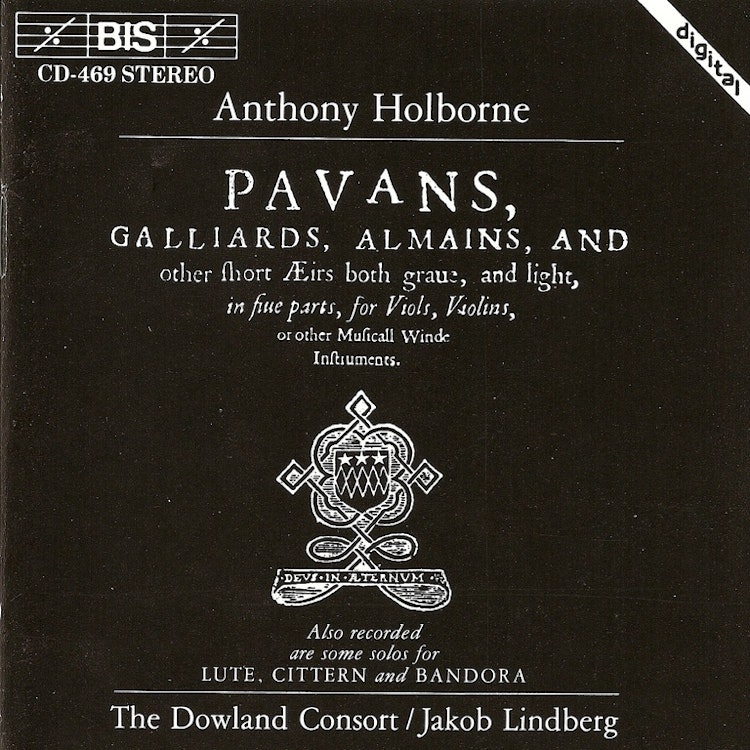
Holborne: Pavans, Galliards, Almains, and Other Short Airs (Selections)
8/1/1992, 21 Tracks, 1:08:48
Featuring
Jakob Lindberg
Dowland Consort
Anthony Holborne
Did you know?
1/7
Compositional Technique
A remarkable feature of Holborne's music is its easy transferability between different instrumental mediums, with the same pieces appearing for consort, lute, cittern, or bandora.
Composer Biography
Anthony Holborne's death was likely caused by a diplomatic mission he undertook for Sir Robert Cecil, Secretary of State to Queen Elizabeth I, as described in a letter from his widow.
Composer Biography
Anthony Holborne, an exact contemporary of Queen Elizabeth I, was called 'the most excellent Anthony Holborne' by John Dowland, a famous lutenist and composer.
Instruments
Holborne's compositions form a major part of the surviving music for lute, bandora (a sonorous bass instrument with wire strings), and cittern (a treble instrument with four pairs of wire strings).
Composer's Artistic Vision
Holborne was a poet and Latinist with literary and abstract intellectual tastes, contributing verses to publications by other composers and linking him to the circle of Mary Sidney, Countess of Pembroke.
Compositional Technique
The mysterious titles of Holborne's pieces, such as 'The Choise' or 'Heres paternus', may be linked to the 'emblem books' studied by the intellectual circle of Mary Sidney, Countess of Pembroke, suggesting esoteric meanings.
Composer's Artistic Vision
Holborne's music is noted for its characteristic liveliness, sophistication, and clarity, without the melancholy and exaggeration sometimes found in the music of the later Jacobean age.
You might also enjoy...
Ambarabà: Works by Saint-Saëns, Henze & Others
La cetra d'Orfeo
Ostinati Balli
Italian Renaissance Dances Vol. 2
Luzzaschi & Agostini: Le concert secret des Dames de Ferrare
Jácaras! - 18th Century Spanish Baroque Guitar Music of Santiago de Murcia
Mudarra, A.: 3 Libros De Musica
Love Is the Cause: Scottish Tunes for Viola da gamba & baroque Guitar