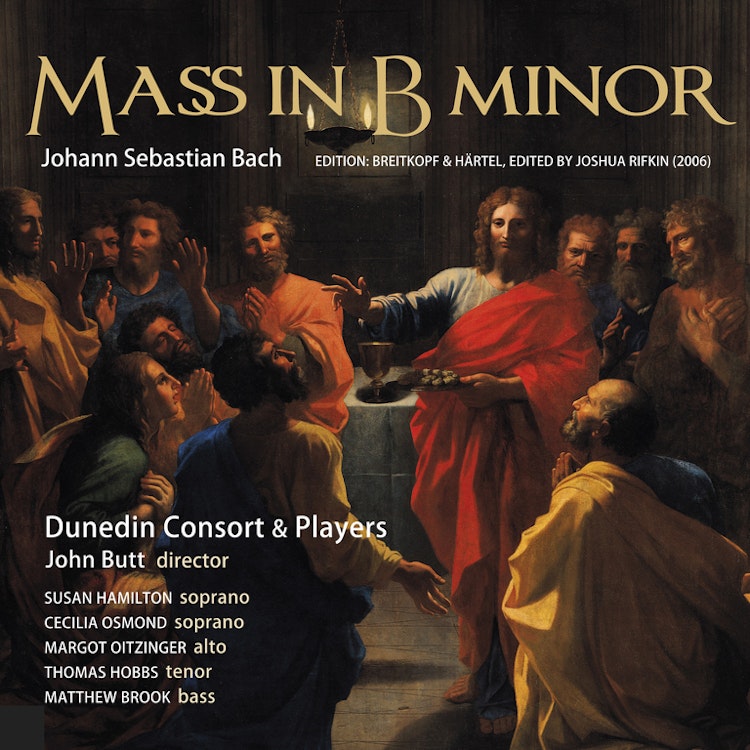
J.S. Bach: Mass in B Minor (Breitkopf & Härtel Edition, edited by J. Rifkin, 2006)
5/17/2010, 27 Tracks, 1:42:07
Featuring
Susan Hamilton
Cecilia Osmond
Margot Oitzinger
Thomas Hobbs
Matthew Brook
John Butt
Dunedin Consort
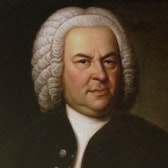
Johann Sebastian Bach
Did you know?
1/7
Compositional Technique
Bach's Mass in B Minor incorporates a wide range of historical styles, from Renaissance-style textures with plainsong cantus firmus to eighteenth-century Italianate concerto style, and even dance-like allusions.
Performer Biography
John Butt, the director of the Dunedin Consort, is a distinguished Bach scholar who has published several books on Bach's music, including a handbook on the Mass in B Minor.
Recording & Production
The harpsichord used in this recording is a 1987 instrument made by Denzil Wraight, modeled after a 1693 Italian harpsichord attributed to Giovanni Battista Giusti.
Composition History
Bach's Mass in B Minor is a compilation of four discrete sections, with the Kyrie and Gloria (Missa) completed in 1733 when Bach was seeking an honorary title from the Elector of Saxony.
Composer's Artistic Vision
Bach often sought to unite the sacred with the best that the secular world could offer, a concept that resonated with Romantic aesthetics.
Critical Reception
The Mass in B Minor was not available in print until nearly a century after Bach's death, and its first performances in the early 19th century were by amateur choral societies.
Interpretation
This recording uses the 2006 Breitkopf & Härtel edition of the Mass in B Minor, edited by Joshua Rifkin, which removes post-1750 'improvements' and accounts for Bach's revisions.
You might also enjoy...
J.S. Bach: Mass in B Minor
J.S. Bach: Mass in B Minor, BWV 232
Handel: Messiah, HWV 56
Heinrich Schütz.: Motets / German Magnificat (Dresden Kreuzchor, Mauersberger)
Bach: Mass in B Minor, BWV 232
Francesco Scarlatti: Dixit Dominus – Mass
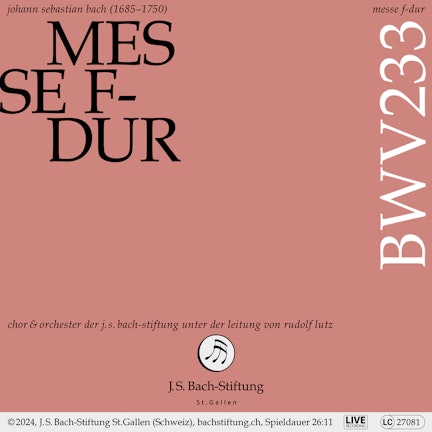
J.S. Bach: Mass in F Major, BWV 233
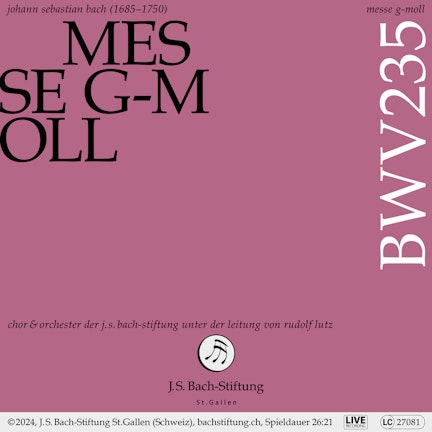
J.S. Bach: Mass in G Minor, BWV 235
Alessandro Scarlatti: Il Martirio di Santa Teodosia
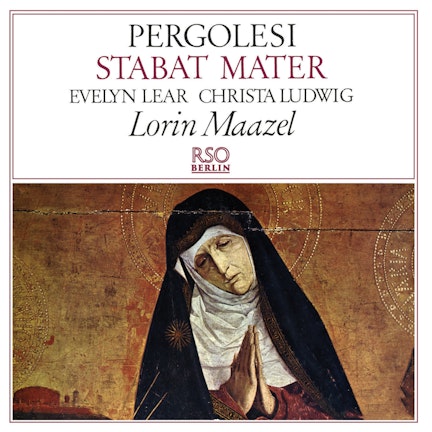
Pergolesi: Stabat Mater
Bach Mass in B Minor conducted by Hermann Scherchen
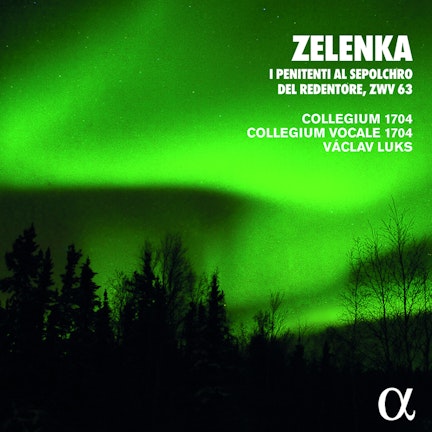
Zelenka: I penitenti al sepolchro del redentore, ZWV 63