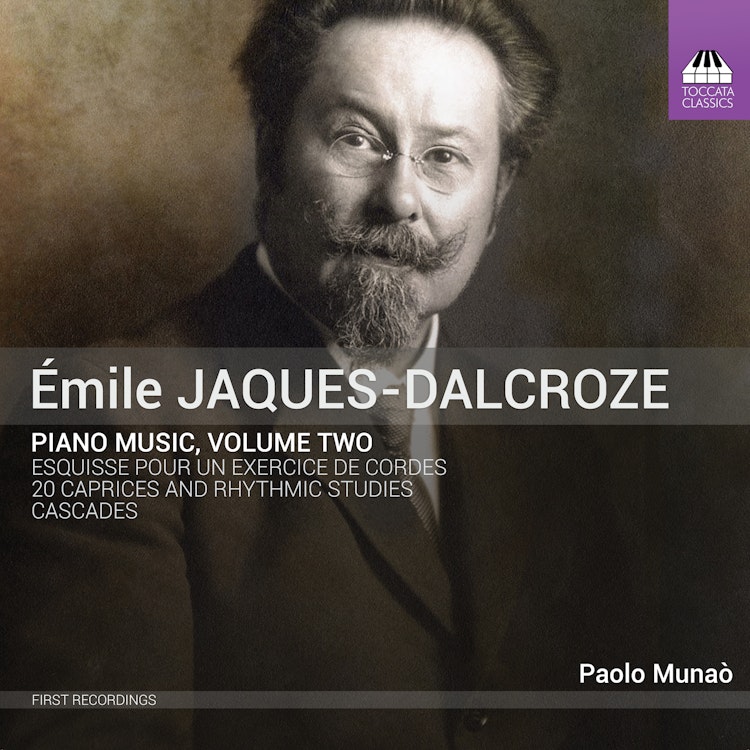
Émile Jaques-Dalcroze, born in Vienna in 1865, studied piano and composition in Geneva and Vienna, including with Anton Bruckner.
Compositional Technique
Jaques-Dalcroze's piano music, particularly the 20 Caprices and Rhythmic Studies, features harmonies with 'impressionist' colors, melodic lines freed from bar-line constraints, and subtle rhythmic profiles.
Composer's Artistic Vision
Jaques-Dalcroze explicitly requested that his 20 Caprices and Rhythmic Studies be performed without rubato, emphasizing strict adherence to his precise indications.
Composer's Artistic Vision
Jaques-Dalcroze developed the 'Méthode Jaques-Dalcroze', also known as 'Eurhythmics', which emphasizes a physical and instinctive perception of rhythm in music education.
Historical Context
In 1911, Jaques-Dalcroze established an institute in Hellerau near Dresden dedicated to teaching rhythm, which attracted intellectuals from across Europe and influenced the performing arts.
Performer Biography
Paolo Munaò, the pianist on this recording, is a winner of the prestigious Premio Claudio Abbado (2015) and the UNESCO Aschberg Prize for Artists (2004).
Compositional Technique
The 20 Caprices and Rhythmic Studies by Jaques-Dalcroze show influences from Stravinsky and Les Six, as well as jazz, in their directness and rhythmic language.
You might also enjoy...
Just a Thought
Tanya Ekanayaka: 12 Piano Prisms
Jorge Grundman: Little Great Stories
Horn Romantic Album
Oppel: Piano Music, Vol. 1
Pomer, J.: Quimera (La) / Mazurkas Nos. 1 and 3 / Piano Sonatina / El Exconvento De San Francisco En Pachuca / Piano Sonata, "El Presagio"
Travels in my Homeland: Portuguese Piano Music
23 Vocalise-études (Arr. for Alto Saxophone & Piano)
Autumn
Rarities of Piano Music At "Schloss vor Husum" from the 2010 Festival
Tuba Europa: A musical journey through the continent