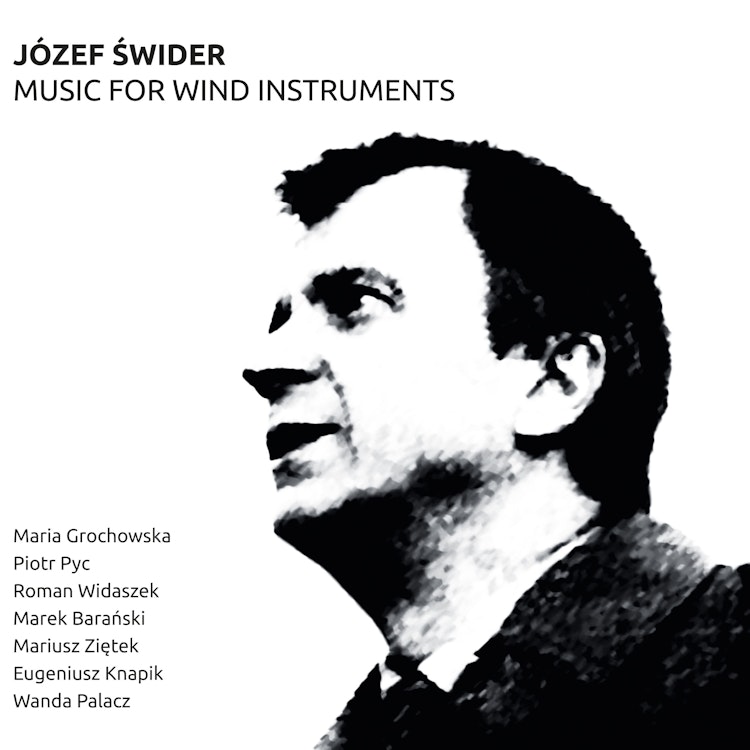
Józef Świder remained faithful to musical Neoclassicism with a romantic-lyric shade, a style described as 'music in waiting for Postmodernism' by Jolanta Szulakowska-Kulawik.
Composition History
The Allegretto for flute and piano (1952) and Andante for oboe and piano (1951) were only discovered among Józef Świder's 'academic papers' after his death, remaining unknown for over 60 years.
Performer Biography
Roman Widaszek, the clarinetist on this album, is one of the few clarinetists who also plays the rare basset horn, an alto clarinet.
Compositional Technique
Józef Świder's Sonata for bassoon and piano (1954) shows a modernization of his musical language, moving away from traditional tonal categories to a 'freed' twelve-tone material.
Composition History
Many of Józef Świder's wind instrument pieces were composed specifically for outstanding musicians from the Polish National Radio Symphony Orchestra and the Silesian Philharmonic, who were also his friends.
Recording & Production
This album features the premiere recording of the complete seven-movement version of Józef Świder's Mini-Quintetto, which was originally a five-movement work from 1993 with two movements added in 2005.
Composer Biography
Józef Świder, a graduate of composition from the State Higher School of Music in Katowice, never engaged with musical avant-garde, unlike his contemporaries Henryk Mikołaj Górecki and Wojciech Kilar.
You might also enjoy...
Rossini: Sonate a quattro per fiati
Una Voce. Per Clarone
Una Voce.........Per Clarone
Ibert: Oeuvres pour vents
New American Masters, Vol. 5
Bonjour!: French Works for Wind Quintet
Mozart, W.A.: Divertimento, K. Anh. 229, No. 6 / Kessler, T.: Unisono / Francaix, J.: Quartuor