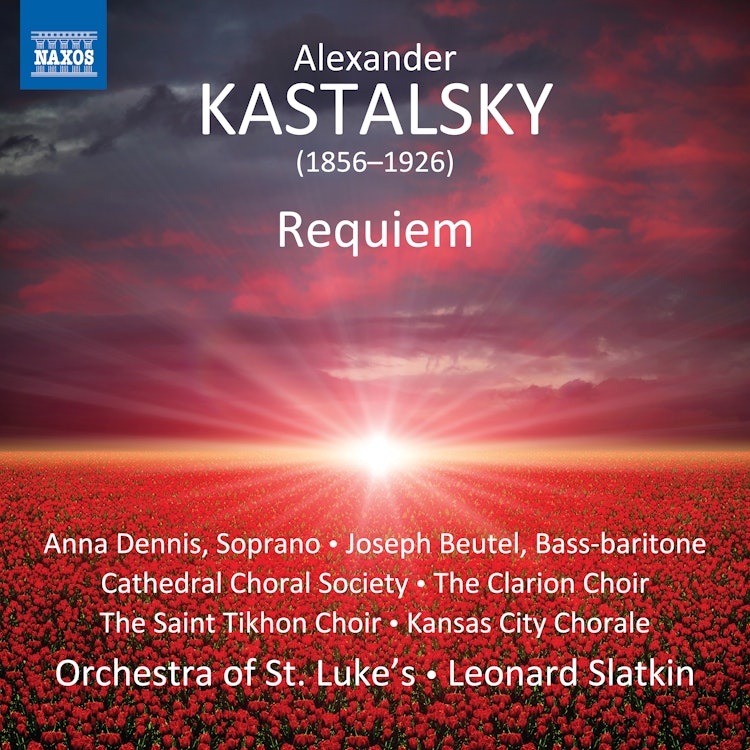
Alexander Kastalsky was a student of Tchaikovsky and a mentor to Rachmaninov, becoming director of the Moscow Synodal School until the Bolshevik regime banned all sacred music, including the extraordinary Requiem for Fallen Brothers which consequently lay forgotten for over a century. This is a world premiere recording.
Alexander Kastalsky was a student of Tchaikovsky and a mentor to Rachmaninov, becoming director of the Moscow Synodal School until the Bolshevik regime banned all sacred music, including the extraordinary Requiem for Fallen Brothers which consequently lay forgotten for over a century. The Requiem is a rich and varied mosaic that honors those who perished in the First World War, poignantly combining Orthodox and Gregorian chant with hymns from the allied nations, even including Rock of Ages. This unprecedented and peerless monument to those who made the ultimate sacrifice was acclaimed on its 1917 premiere as a ‘uniquely Russian requiem that… gave musical voice to the tears of many nations.’ This is a world premiere recording.
Featuring
Anna Dennis
Joseph Beutel
Leonard Slatkin
Cathedral Choral Society
Kansas City Chorale
Chamber Choir of St. Tikhon's Monastery
The Clarion Choir
Orchestra of St. Luke's
Alexander Kastalsky
Did you know?
1/7
Historical Context
Kastalsky's Requiem for Fallen Brothers is the only large-scale choral-orchestral work written specifically in response to the unprecedented loss of life in the First World War.
Compositional Technique
The music of Kastalsky's Requiem for Fallen Brothers resembles a rich and varied mosaic, often providing options for Latin, English, or Russian text, allowing performers discretion in language choice.
Composition History
Alexander Kastalsky began planning his Requiem for Fallen Brothers in the summer of 1914, conceiving it as a musical collage combining prayers for the dead from various Allied liturgical traditions.
Composer Biography
Alexander Kastalsky, a student of Tchaikovsky, was affiliated with the Moscow Synodal School of Church Singing until it was closed by the Bolsheviks in 1918.
Cultural Impact
Kastalsky's Requiem for Fallen Brothers, an unprecedented and peerless monument to those who made the ultimate sacrifice in WWI, lay forgotten for over a century due to the Bolshevik regime banning sacred music.
Critical Reception
At its 1917 premiere, Kastalsky's Requiem for Fallen Brothers was acclaimed as a "uniquely Russian Requiem" that gave musical voice to the tears of many nations.
Composer's Artistic Vision
Kastalsky imagined his Requiem as having an all-encompassing, dramatic character, containing elements of both a sacred mystery play and a civic ceremony.