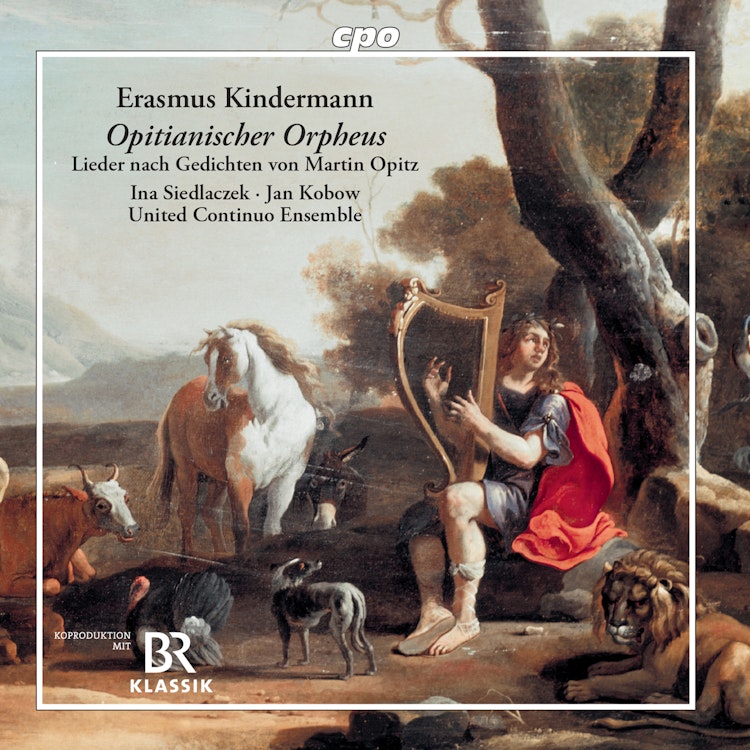
Jan Kobow, a tenor on this recording, won first prize at the Leipzig Bach Festival in 1998 and has since become internationally renowned for his interpretations of baroque music.
Composition History
Kindermann's 'Opitianischer Orpheus' is a two-volume collection of settings of poems by Martin Opitz, a German poet who sparked a craze for German-language literature in the 17th century.
Compositional Technique
The songs in 'Opitianischer Orpheus' are mostly strophic for a single voice and figured bass, with optional violins and violon (or bassoon) providing ritornellos.
Composer's Artistic Vision
Kindermann subtitled his settings 'musical delights,' aiming to convey joy, stimulation, and pleasure rather than composing laments for the difficult times.
Historical Context
Kindermann lived during the Thirty Years' War, a harrowing period in European history that severely impacted his hometown of Nuremberg.
Composer Biography
Johann Erasmus Kindermann, the composer, lived a short life, dying at 39 in his native Nuremberg in 1653.
Composer's Artistic Vision
Kindermann deliberately chose chamber music for 'Opitianischer Orpheus', intending it for humanistically educated music-lovers with literary ambitions to perform or listen to in social gatherings.