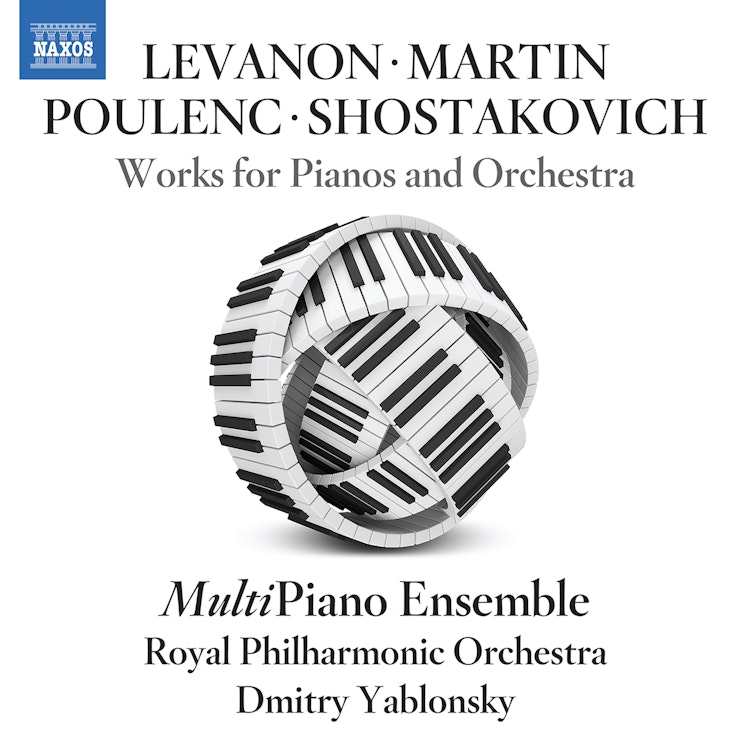
Martin, Poulenc & Others: Works for Pianos & Orchestra
11/11/2022, 11 Tracks, 1:00:42
Featuring
Dmitry Yablonsky
Tomer Lev
Berenika Glixman
Daniel Borovitzky
Almog Segal
Nimrod Meiry-Haftel
MultiPiano Ensemble
Royal Philharmonic Orchestra
Frank Martin
Francis Poulenc
Dmitri Shostakovich
Arie Levanon
Did you know?
1/7
Historical Context
Neo-Baroque trends after the First World War led to a revival of the group concerto tradition, reinterpreting and giving new life to neglected forms.
Compositional Technique
Poulenc's Concerto for Two Pianos features a 'polystylism' that blends diverse elements like street melodies, Parisian chansons, Stravinsky-style rhythms, and Asian gamelan bells.
Composer Biography
Shostakovich's Concertino for Two Pianos was written for him and his son, Maxim Shostakovich, who later became a well-known conductor.
Interpretation
Frank Martin himself re-wrote his Petite symphonie concertante as a purely orchestral composition in 1950, without soloists, to allow for wider performance due to its experimental nature.
Compositional Technique
Frank Martin's Petite symphonie concertante was originally scored for the unusual combination of piano, harp, and modern harpsichord solos with a double string orchestra.
Composition History
The practice of composing concertante works for multiple solo keyboard instruments and orchestra was common in the 18th and early 19th centuries, as seen in works by Bach and Mozart.
Composer's Artistic Vision
Aryeh Levanon's Land of Four Languages uses traditional songs from four different communities in Israel to symbolize hope for peace and harmony.
You might also enjoy...
Clara Schumann: Piano Concerto & Works by Hiller, Herz & Kalkbrenner (Hyperion Romantic Piano Concerto 78)
Piano Concertos from the Netherlands
Poulenc Concertos
Różycki: Piano Concertos Nos. 1 & 2 etc. (Hyperion Romantic Piano Concerto 67)
Aloys Schmitt: Piano Concertos Nos. 1 & 2 etc. (Hyperion Romantic Piano Concerto 84)
Wölfl: Piano Concertos
Potter: Piano Concertos Nos. 2 & 4 (The Romantic Piano Concerto 72)
Poulenc: Concerto pour deux pianos et orchestre, Concert Champêtre & Suite Française
Tveitt: Piano Concertos Nos. 1 and 4
Godard: Piano Concertos (Hyperion Romantic Piano Concerto 63)
Malcolm Williamson: The Complete Piano Concertos
Stravinsky: Concerto for Piano, Capriccio, Movements & Petrushka
Gubaidulina, Ustvolskaya, Górecki & Pelécis : Piano Concertos