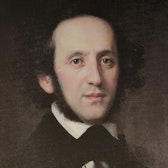
Felix Mendelssohn was the grandson of Moses Mendelssohn, a great Jewish thinker, and took the additional name Bartholdy upon his baptism as a Christian.
Composition History
The English Christmas hymn "Hark, the herald angels sing" originated from Mendelssohn's Festgesang, which he also wrote for the Gutenberg celebration.
Critical Reception
Richard Wagner, a German composer, criticized Mendelssohn's 'Lobgesang' as a "feeble copy" of Beethoven's Ninth Symphony, calling it a "mere symphony with choruses."
Composition History
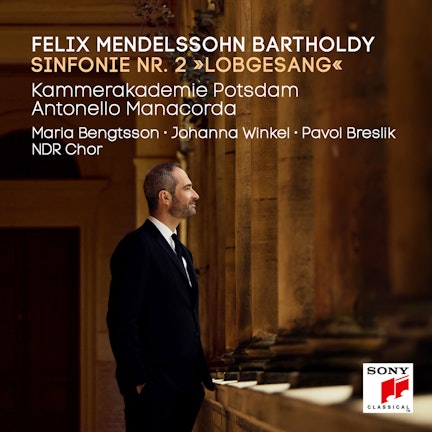
Mendelssohn wrote his Symphony No. 2, 'Lobgesang' (Hymn of Praise), in 1840 to celebrate the 400th anniversary of Gutenberg's invention of printing with movable type.
Composer's Artistic Vision
Mendelssohn described his Symphony No. 2 as a "symphony-cantata" and used texts from the Luther Bible, quoting Luther's desire to see all arts, especially music, in God's service.
Performer Biography
Christian Elsner, a tenor on this recording, is also an enthusiastic writer of children's books, including "Lennie und die Zauberfloete" and "Lennie in der Wolfsschlucht."
Compositional Technique
A fanfare-like trombone motif introduced in the Sinfonia of Mendelssohn's 'Lobgesang' recurs throughout the entire symphony, notably in transitions and the final chorus.