Cristóbal de Morales was a prominent composer of sacred music in Western Europe between the death of Josquin in 1521 and the rise of Palestrina and Lassus in the 1550s.
Composition History
Morales's Requiem, or Missa pro defunctis, in five voices, was published in his second book of Masses in 1544 and was likely written during his time in Rome.
Compositional Technique
The sequence Dies irae, a conspicuous movement in many Requiems, is omitted from Morales's work because it was not part of the funeral liturgy in Rome or Spain during his time.
Album & Artwork
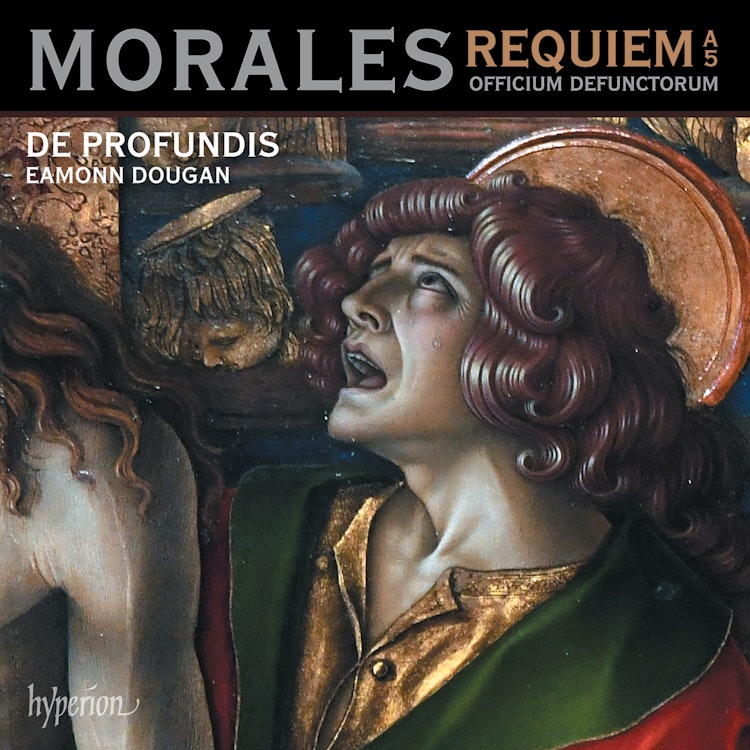
This album is the second in a planned series of twelve that will record all of Cristóbal de Morales's Masses and Magnificats, a project launched by De Profundis in 2022.
Compositional Technique
Morales's Requiem uses a disarming simplicity, with the chant for the Mass for the Dead lightly paraphrased in the top voice, supported by dignified lower voices.
Composer Biography
Morales, who was born around 1500 in Seville, had talented teachers like Pedro de Escobar and Francisco de Peñalosa, the latter of whom is also featured on this album.
Critical Reception
The 19th-century music historian August Wilhelm Ambros described Morales's Requiem as 'unique in its terrible magnificence, gloomy and bleak,' evoking a walk among dark tombs.
You might also enjoy...
Vocal Music (Renaissance) - Victoria, T.L. De / Gesualdo, C. / White, R. / Palestrina, G.P. Da (Lamentations)
Refuge from the Flames, Miserere and the Savonarola Legacy