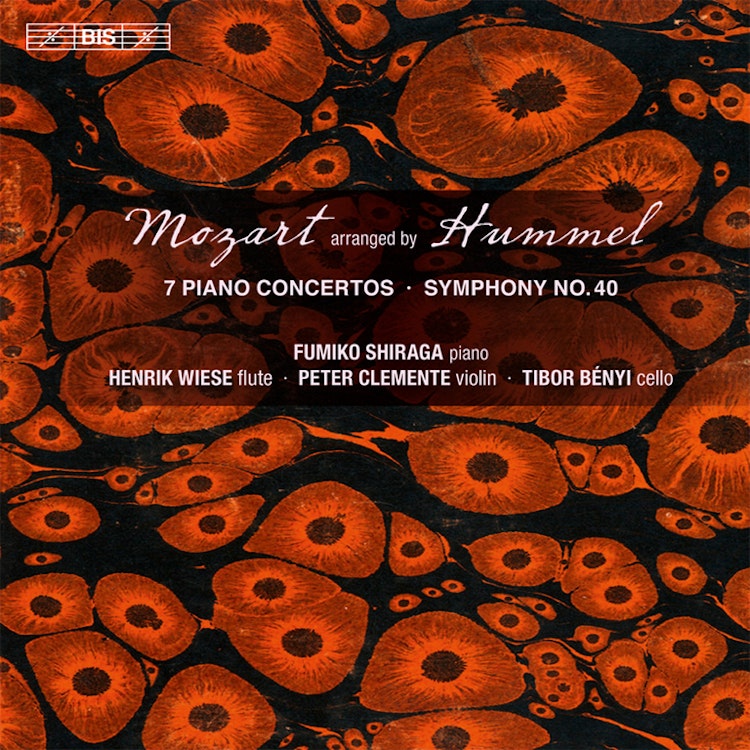
Mozart: 7 Piano Concertos - Symphony No. 40 arranged by Johann Nepomuk Hummel
5/28/2013, 25 Tracks, 4:14:51
Featuring
Fumiko Shiraga
Henrik Wiese
Peter Clemente
Tibor Benyi
Wolfgang Amadeus Mozart
Did you know?
1/7
Instruments
The arrangements reflect the advancements in piano design after 1820, including a wider tonal range, greater dynamics, and a seven-octave range.
Composition History
These chamber arrangements of Mozart's piano concertos and Symphony No. 40 were undertaken by Johann Nepomuk Hummel for the publisher Schott in the 1830s.
Compositional Technique
In these arrangements, Hummel combined the orchestral parts, solo line, and his own ornamentations into a full piano part, with the flute, violin, and cello providing accompaniment.
Interpretation
Hummel's metronome markings for Mozart's Symphony No. 40 indicate very fast tempos, similar to Beethoven's markings, reflecting Viennese taste of the time.
Composer's Artistic Vision
Hummel's arrangements are considered a conscientious virtuoso approach to the works of Mozart, whom he revered as a teacher.
Composer Biography
Johann Nepomuk Hummel, the arranger, received two years of tuition in Mozart's house as a boy, studied under Joseph Haydn, and was friends with Beethoven.
Historical Context
These quartet versions of Mozart's works document a common musical practice from the early 19th century, despite seeming unusual today.
You might also enjoy...
Mozart: Piano Trios (Complete)
Schubert: Octet in F Major
Schubert: Octet for Strings and Winds in F Major, D. 803