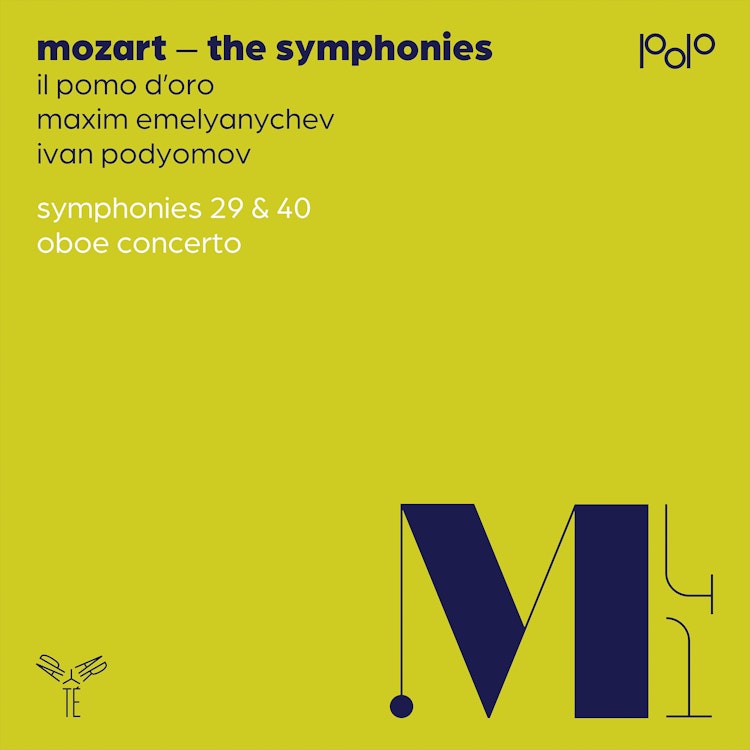
Symphony No. 40 features dense counterpoint throughout, including a new countermelody in the bassoon during the first movement's recapitulation and fugato passages in the third and fourth movements.
Composer Biography
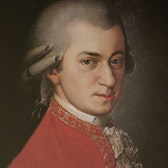
Mozart moved to Vienna in 1781, aspiring to secure a permanent position at the imperial court, which he eventually obtained in 1787 as k.k. Kammermusikus (Imperial Royal Chamber Musician).
Composition History
Mozart composed his final three symphonies, including Symphony No. 40, in just a few weeks between July and August 1788, a little over a year after his father's death.
Composer Biography
Mozart's Oboe Concerto was composed just before he embarked on a sixteen-month European tour between 1777 and 1779, which ultimately led to his dismissal from Archbishop Colloredo's service.
Instruments
Ivan Podyomov, the oboe soloist, plays an oboe made by Marcel Ponseele in 2021, modeled after a Jakob Friedrich Grundmann instrument from around 1787.
Recording & Production
This album was recorded by Little Tribeca from February 9 to 11, 2023, at the Sala della Carità, Scuola della Carità, in Padua.
Compositional Technique
The Oboe Concerto grants an exceptional privilege: each movement includes its own cadenza, a feature not found in any of Mozart's piano concertos.