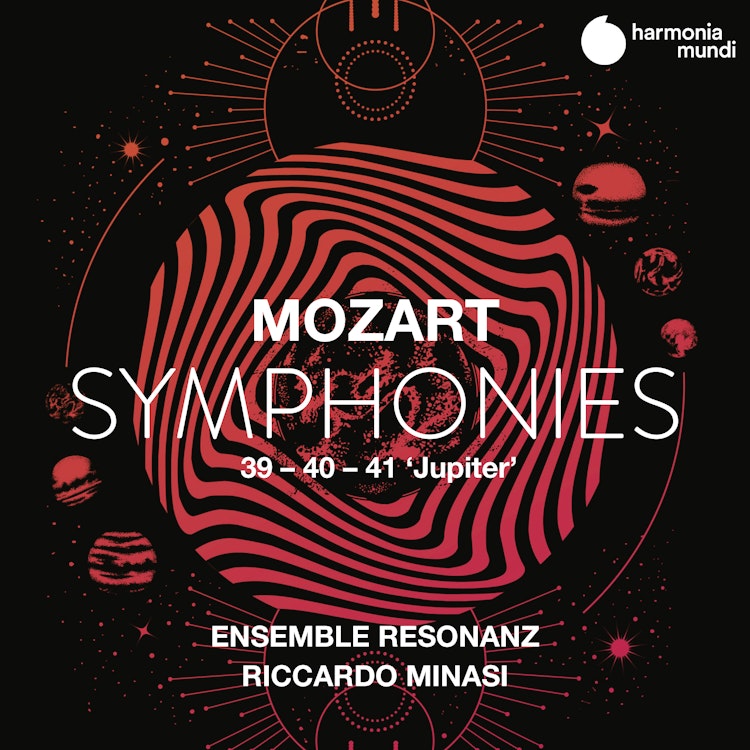
The innovative Hamburg-based chamber orchestra Ensemble Resonanz continue their exploration of the Classical repertoire – which previously produced albums of C.P.E. Bach and Haydn – with a recording of Mozart's legendary three final symphonies. Riccardo Minasi conducts the group in the Symphonies No. 39, 40 and 41 "Jupiter".
Featuring
Riccardo Minasi
Ensemble Resonanz
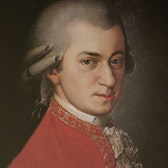
Wolfgang Amadeus Mozart
Did you know?
1/7
Composer's Artistic Vision
The finale of Symphony No. 41 'Jupiter' showcases Mozart's mastery of counterpoint on a symphonic scale, using its two most prominent themes as the subject and countersubject of a fugue.
Composer's Artistic Vision
The first theme of Symphony No. 41 'Jupiter' uses a four-note motif (C-D-F-E) that Mozart had previously used in sacred works and earlier symphonies, creating a significant intertextual link.
Composition History
Mozart composed his last three symphonies—Symphony No. 39, No. 40, and No. 41 'Jupiter'—in a very brief period during the summer of 1788.
Composer Biography
Mozart composed these symphonies while grieving the loss of his baby daughter Theresia and facing severe financial distress.
Historical Context
Austria was experiencing a terrible economic crisis in 1788 due to its entry into a war against the Ottoman Empire, leading to inflation, famine, and epidemics that relegated artistic life to the background.
Compositional Technique
Symphony No. 40 in G minor, a work of great distress, was later softened by Mozart with the addition of clarinets to mitigate the acid timbre of the oboes.
Recording & Production
This album was recorded in July 2019 at the Friedrich-Ebert-Halle in Hamburg, Germany.
You might also enjoy...
Mozart: Symphonies Nos. 39, 40 & 41
Mozart: Orchestral Works
Fricsay conducts Mozart
Mozart: Le Nozze di Figaro (Overture), Symphony No. 40 - Joseph Haydn: Symphonies Nos. 88 & 94
Mozart: Symphonies Nos.40 & 41
Richter & Kohout: Works for Orchestra
Mozart: Symphonies Nos. 40 & 41
C.P.E. Bach: Berlin Symphonies I
«Sein» works by Mozart - Syrse - Haydn - J.-C. Bach