This recording uses a performance pitch of about A465, a semitone above A440, which is the most usual choir pitch of the continent and close to the historical English 'Quire-pitch' of A473-478.
Performer Biography
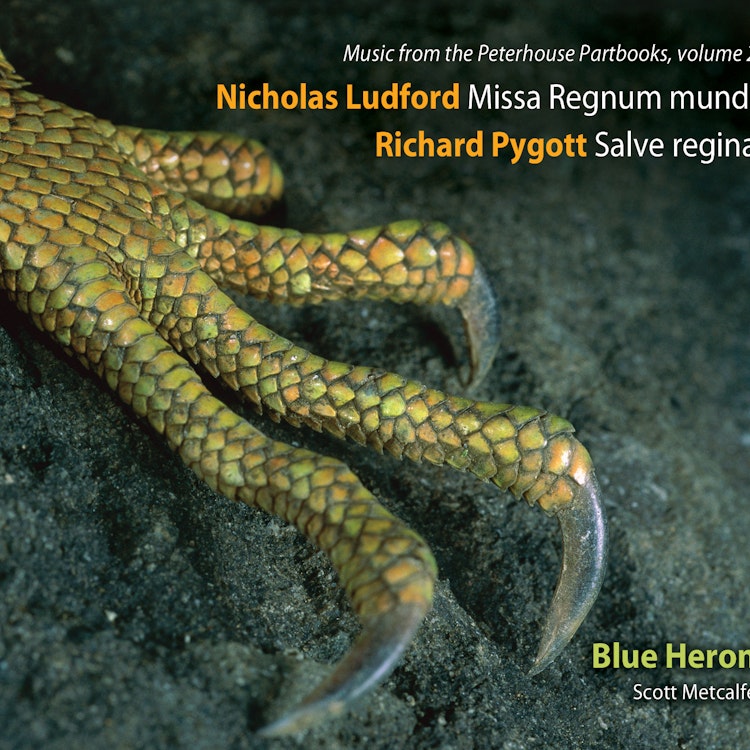
Blue Heron, the vocal ensemble on this album, was founded in 1999 and has been acclaimed for its 'expressive intensity' and its commitment to historical performance practices.
Compositional Technique
The missing parts of the music, including entire tenor lines and some treble parts, have been reconstructed by English musicologist Nick Sandon, whose work is performed on this recording.
Compositional Technique
The Peterhouse partbooks, which contain the music on this album, originally comprised five partbooks, but the tenor partbook and several pages of the treble book are now lost.
Historical Context
The Peterhouse partbooks, a collection of polyphonic music, were copied around 1539-1540 by Thomas Bull for the newly refounded Canterbury Cathedral, which aspired to more elaborate music than its monastic predecessor.
Composition History
Nicholas Ludford's Missa Regnum mundi was likely composed for a festal mass on St. Margaret's feast day, July 20, at St. Margaret's, Westminster, where Ludford was an active parishioner.
Historical Context
During the Protestant Reformation in England, much elaborate polyphonic music was destroyed or repurposed, with some manuscripts used as wrapping paper or for cleaning.