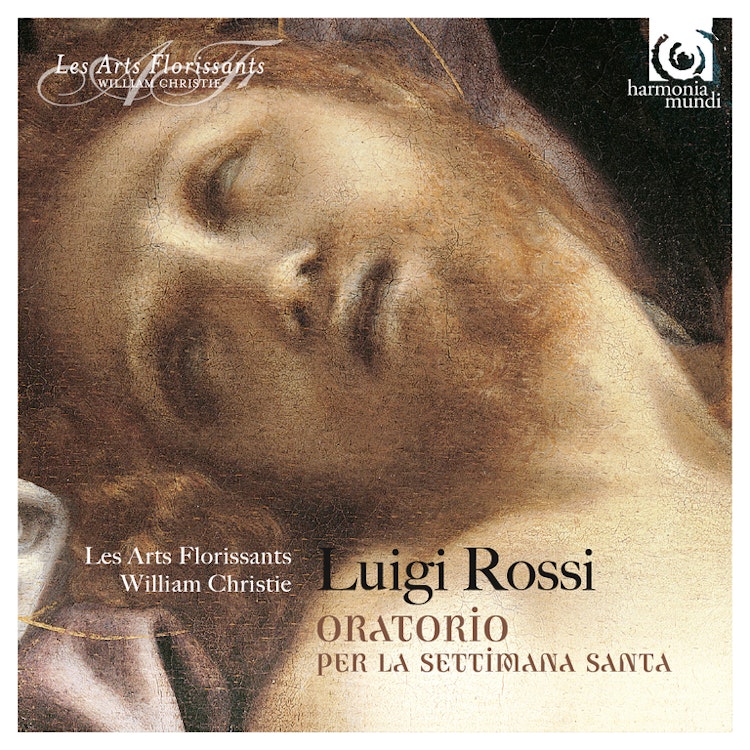
In late 16th and early 17th century Italy, 'spiritual exercises' involved prayers, sermons, and music in Italian, often held in prayer halls rather than churches, to intensify religious fervor.
Compositional Technique
Unusually for a 17th-century oratorio, this work lacks a narrator's part, known as the Testo, which would typically tell the story in recitative, similar to the Evangelist in a liturgical Passion.
Composition History
While the attribution to Luigi Rossi is debated, it is generally accepted that these oratorios were composed by one of Rossi's Roman contemporaries serving the Barberini family, possibly Marc'Antonio Pasqualini.
Compositional Technique
The libretto for 'Oratorio per la Settimana Santa' by Giulio Cesare Raggioli, maestro da camera to Taddeo Barberini, is characteristic of 17th-century oratorios with its two-part structure and dialogue between soloists and ensembles.
Composition History
The earliest compositions designated as 'oratorio' in their manuscript sources, including the works on this recording, date from mid-17th century Rome.
Composer Biography
These oratorios were initially attributed to Luigi Rossi, a composer who worked for Cardinal Antonio Barberini in Rome, a patron of music and nephew of Pope Urban VIII.
Composition History
The term 'oratorio' initially referred to both a prayer hall and the spiritual exercise conducted there, but by mid-17th century, it also designated a musical composition performed during such exercises.
You might also enjoy...
Charpentier : Motets for Double Choir
Schütz, Praetorius, Schein & Demantius: 17th Century Funeral Music
Schütz: Musikalische Exequien
Schütz, Praetorius, Schein & Demantius: 17th-Century Funeral Music
Choral Concert: Schutz Academy - SCHUTZ, H. / PRAETORIUS, M. / SCHEIN, J.H. / DEMANTIUS, C.
M.A. Charpentier: Cæcilia Virgo et Martyr, H.413 - Filius prodigus, H.399 - Magnificat, H.73
Zelenka: Missa Gratias agimus tibi
Schutz: Geistliche Chormusik, Op. 11
Desmarets : Grands Motets Lorrains
Heinrich Schütz: Musikalische Exequien
Cantus Cölln-Edition
Marc-Antoine Charpentier: Canticum Ad Beatam Virginem Mariam