Saint-Saëns: Symphony No. 3 in C Minor "Organ Symphony", Introduction et rondo capriccioso in A Minor & La muse et le poète
6/9/2015, 6 Tracks, 1:01:30
Featuring
Michael Stern
Noah Geller
Mark Gibbs
Jan Kraybill
Kansas City Symphony
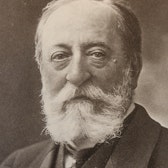
Camille Saint-Saëns
Did you know?
1/7
Composer Biography
Camille Saint-Saëns was a versatile artist, admired as a pianist and organist, who also wrote poetry, drama, and essays on mathematics and ancient music.
Compositional Technique
Saint-Saëns's 'Organ' Symphony, though divided into two parts, effectively contains the traditional four movements, with the first part serving as an introduction to the Adagio and the scherzo connected to the finale.
Composition History
Saint-Saëns dedicated his Symphony No. 3, known as the 'Organ' Symphony, to Franz Liszt, whom he greatly admired and who had supported his career.
Compositional Technique
The 'Organ' Symphony incorporates both the organ and piano (played à quatre mains in some sections) into the large orchestra, instruments on which both Saint-Saëns and Liszt were virtuosos.
Composition History
Saint-Saëns composed his Symphony No. 3 at age 50, conducting its premiere in London in 1886, and considered it his final symphonic effort, stating he had given all he could.
Composition History
The Introduction and Rondo Capriccioso, a popular short piece for violin and orchestra, was composed for the Spanish violinist Pablo de Sarasate when he was only 19 years old.
Compositional Technique
La Muse et le Poète is a late work by Saint-Saëns, combining elements of a double concerto for violin (the Muse) and cello (the Poet) with a symphonic poem.
You might also enjoy...
French Showpieces (Concert Francais)
Berlioz: Harold in Italy . Rêverie et caprice
Berlioz - Orchestral Works
Mendelssohn Concerto / Havaniase / Etc.
Richard Flury: Orchestral Music, Vol. 2
Messiaen: Orchestral Works
Pierne, G.: Impressions De Music-Hall Suite / Izeyl Suite / Fantaisie Basque Sur Des Themes Populaires Basques Espagnols / Divertissement
Vincent d'Indy: Wallenstein & Other Orchestral Works
Messiaen: Orchestral Works
Bartók: Concerto for Orchestra, Violin Rhapsodies & Dance Suite
Le Boeuf sur le toit
Stravinsky: The Flood; Abraham and Isaac; Variations; Requiem Canticles / Wuorinen: A Reliquary for Igor Stravinsky
Tan, Dun: Out of Peking Opera / Death and Fire / Orchestral Theatre Ii