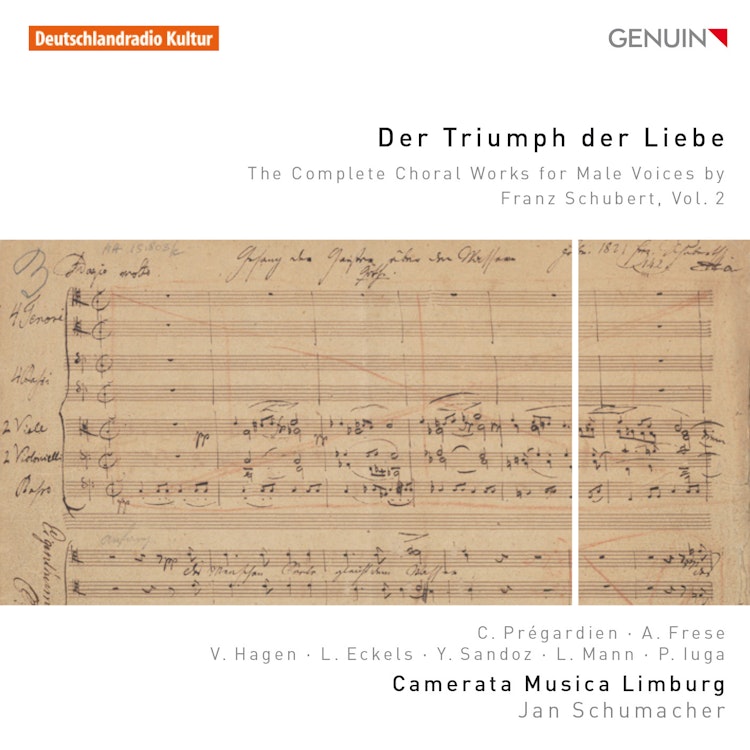
Schubert: Der Triumph der Liebe – The Complete Choral Works for Male Voices, Vol. 2
5/6/2016, 27 Tracks, 1:06:47
Featuring
Jan Schumacher
Veronika Hagen
Lena Eckels
Yves Sandoz
Lilian Mann
Petru Iuga
Andreas Frese
Christoph Prégardien
Camerata Musica Limburg
Franz Schubert
Did you know?
1/7
Compositional Technique
Schubert set Johann Wolfgang von Goethe's poem "Gesang der Geister über den Wassern" four times, with the fourth arrangement (D 714) uniquely scored for eight-part male choir, two violas, two cellos, and double bass.
Critical Reception
Schubert's complex composition "Gesang der Geister über den Wassern" (D 714) was too much for both the public and performers at its first performance in 1821, due to its harmonic and formal complexity.
Performer Biography
Camerata Musica Limburg, the male choral ensemble on this album, emerged from the shared musical roots of its members in the Limburg Cathedral Boyschoir.
Historical Context
Due to the political turmoil of the Napoleonic Wars, some of Schubert's compositions were based on patriotic and martial themes, which are prominently featured on this album.
Composition History
Most of Schubert's part-songs were written for Schubertiads, convivial gatherings where participants played music and discussed literature and politics in a relaxed atmosphere.
Composer Biography
For almost his entire life, Franz Schubert, the composer, devoted himself to polyphonic vocal works, which were among his first compositions as a boarding school student.
Composer's Artistic Vision
Schubert was inspired by James Macpherson's poetry, an alleged translation of the Gaelic poet Ossian, and set nine Ossian texts to music as solo songs, as well as one work for male voices.
You might also enjoy...
Die Einsiedelei: The Complete Choral Works for Male Voices by Franz Schubert, Vol. 4
Schubert: Mannerchore
Wehmut: The Complete Choral Works for Male Voices by Franz Schubert, Vol. 3
Schubert: Die Winterreise, Op. 89, D. 911
Czech Songs
Elysium: The Complete Choral Works for Male Voices by Franz Schubert, Vol. 5
Folk Songs
Schubert: Nachtgesang im Walde
Schubert : Complete Secular Choral Works
Jean Absil: Trésors d'enfance
Ständchen: Works for Male Choir
Schubert: Das geistliche & weltliche Chorwerk · Sacred & Secular Choral Works