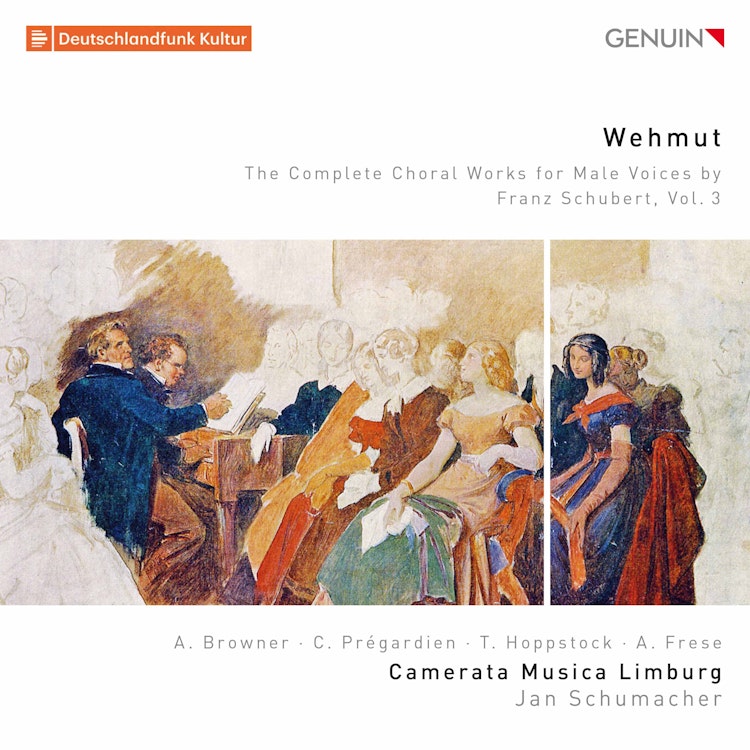
Wehmut: The Complete Choral Works for Male Voices by Franz Schubert, Vol. 3
10/6/2017, 20 Tracks, 1:01:00
Featuring
Jan Schumacher
Tilman Hoppstock
Alison Browner
Andreas Frese
Christoph Prégardien
Camerata Musica Limburg
Franz Schubert
Did you know?
1/7
Composition History
Many of Schubert's part-songs were composed for Schubertiades, which were informal gatherings where friends made music and discussed literature and politics.
Composer Biography
Franz Schubert composed vocal ensemble works throughout his entire life, starting from his earliest surviving compositions as a seminary pupil.
Compositional Technique
In Wehmut (Die Abendglocke tönet) D 825, Schubert imitates the sound of an evening bell throughout the piece using a continually repeated note in the first bass.
Composition History
Schubert's Ständchen (Zögernd leise) D 920 for men's choir and solo alto was commissioned by singer Anna Fröhlich, who actually intended it for a women's choir.
Notable Performances
Das Dörfchen D 598 and Die Nachtigall D 724 were among Schubert's most frequently performed works during his lifetime, often appearing in public concerts.
Composition History
The work Beitrag zur fünfzigjährigen Jubelfeier des Herrn von Salieri D 407 was composed by Schubert for a celebration honoring his former teacher, Antonio Salieri, in June 1816.
Composition History
The publication of Das Dörfchen D 598, Die Nachtigall D 724, and Geist der Liebe D 747 in June 1822 marked the first time Schubert's works for male voices appeared in print.
You might also enjoy...
Schubert: Die Winterreise, Op. 89, D. 911
Schubert: Mannerchore
Elysium: The Complete Choral Works for Male Voices by Franz Schubert, Vol. 5
Schubert: Der Triumph der Liebe – The Complete Choral Works for Male Voices, Vol. 2
Die Einsiedelei: The Complete Choral Works for Male Voices by Franz Schubert, Vol. 4
Wolf: Gedichte von J.W. v. Goethe
The Art Of Hans Hotter
Schubert: 'Trout' Quintet/7 Lieder
Schubert: Schwanengesang - Beethoven: An die ferne Geliebte
Schubert: Winterreisen (Version for Tenor and Piano Trio & Original Version)
Schubert: Schwanengesang
Schubert: Schwanengesang, D. 957 – Beethoven: An die ferne Geliebte, Op. 98
Ian Partridge 85th Birthday Tribute - Stimme der Liebe (The Voice of Love)