Pianist Daniil Trifonov notes that Schubert's works, including the 'Trout' Quintet, are characterized by many accents, sforzandi, and extreme dynamic marks, with 'fortepiano' being the most frequent.
Interpretation
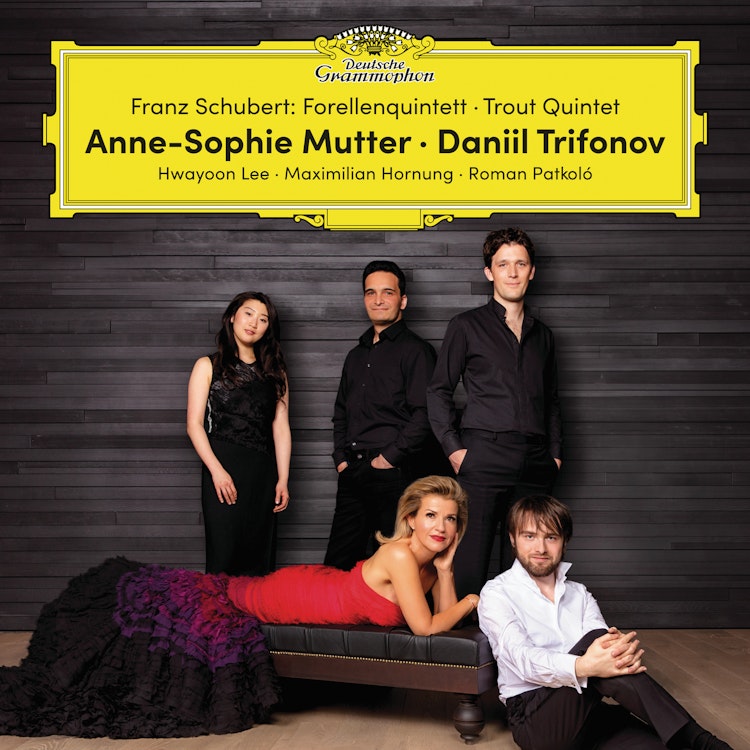
Anne-Sophie Mutter, the violinist, believes the trout in Schubert's quintet is 'as fast as an arrow, vibrant and alive' because Schubert expressly omits the part of the song where the trout dies.
Interpretation
For the Notturno D 897, Anne-Sophie Mutter and Daniil Trifonov decided to omit vibrato when the theme recurs with harp arpeggios in the piano, to impart a sense of tranquility.
Performer Biography
Jascha Heifetz, a renowned violinist, added 'Ave Maria' to his repertoire in 1917 and performed it 211 times by 1950.
Compositional Technique
In the Notturno D 897, Schubert experimented with sounds in the ultra-high piano register and explicitly wrote 'con pedale,' which foreshadows Impressionism.
Composition History
Schubert's 'Trout' Quintet, with its unusual scoring and easy-going levity, was commissioned by the enthusiastic amateur cellist Sylvester Paumgartner.
Composition History
The 'Trout' Quintet's unusual five-movement design and its nickname come from Schubert fulfilling his patron's wish to include his favorite song, 'Die Forelle' (The Trout), as a set of variations.
You might also enjoy...
Stille Musik
Alkan: Chamber Music
Alkan: Chamber Music
Debussy: Violin Sonata; Cello Sonata/Ravel: Piano Trio
Ravel, Fauré & Debussy: Piano Trios & Sonatas
Gerhard, R.: Chamber Music
Sheku Kanneh-Mason
Ravel & Debussy: Chamber Works
Ernest Moeran: Chamber Music
Milford: Chamber Music
A. Beach: Chamber Music for Violin, Cello and Piano
Claude Debussy: Prélude à l'après-midi d'un faune, Cello Sonata, Violin Sonata, Piano Trio
Mendelssohn: Piano Trios Nos. 1 -2 & Songs Without Words