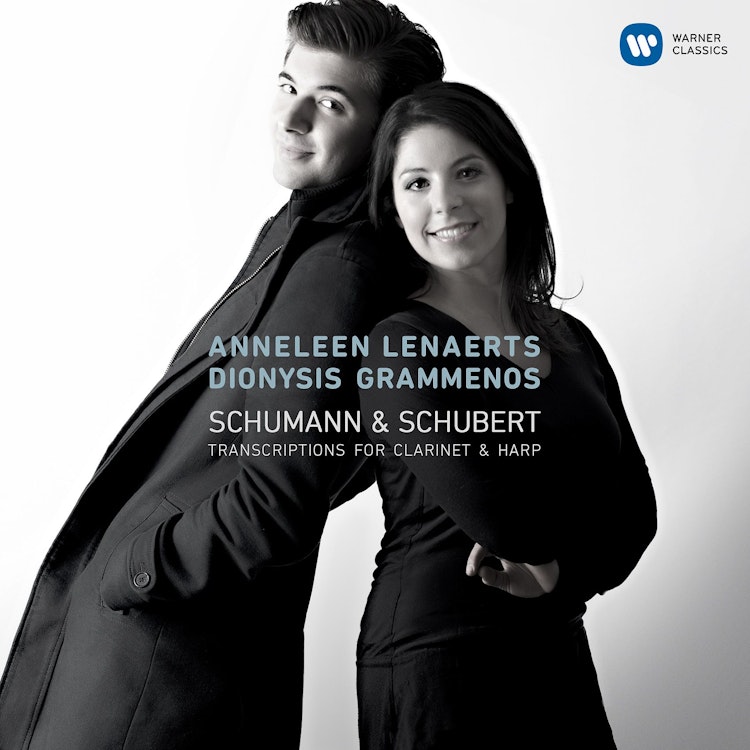
Schumann & Schubert - Transcriptions for Clarinet & Harp
10/21/2016, 13 Tracks, 57:52
Featuring
Dionysis Grammenos
Anneleen Lenaerts
Robert Schumann
Clara Schumann
Franz Schubert
Did you know?
1/7
Composer's Artistic Vision
E.T.A. Hoffmann, in his 1810 essay on Beethoven, privileged instrumental music above all other art forms, calling it "the most romantic of all the arts" because "its sole object is the expression of the infinite."
Instruments
Iwan Müller developed his clarinette omnitonique in 1812, which had thirteen keys and a new 'stuffed pad' system, allowing the Bb clarinet to play in all keys for the first time.
Composition History
Schubert's Arpeggione Sonata in A Minor D821 is always played in transcription because the arpeggione, developed in 1823, fell into disuse just ten years later.
Composer Biography
Robert Schumann identified two aspects of his personality that influenced his compositions: 'Eusebius' for his lyrical, reflective self, and 'Florestan' for his passionate nature.
Recording & Production
This album consists entirely of transcriptions of masterpieces from the German Romantic period, composed in the first half of the nineteenth century.
Composition History
The 'Rückert Lieder' (1850) on this album are a joint project by Robert and Clara Schumann, with all three recorded songs composed by Clara Schumann.
Instruments
In 1810, Sébastien Erard obtained a patent for the double-action pedal harp, an essential development that allowed the harp to play in all keys.
You might also enjoy...
Bartok and Kodaly
Strauss: Music for Wind Instruments, Vol. 2
Richard Strauss : Music for Wind Instruments
The Bottesini Collection, Vol. 4
Strauss: Metamorphosen & Symphony for Wind Instruments
Field: Piano Concertos, Vol. 4
Profanes Et Sacrées: 20th Century French Chamber Music
Villa-Lobos: Bachianas Brasileiras Nos. 1, 4-6
Christmas Songs
Christmas Songs
Jolivet, A.: String Symphony / Yin-Yang / Adagio / La Fleche Du Temps / Andante
Phantasy in Blue: Music for Cello and Saxophone Quintet