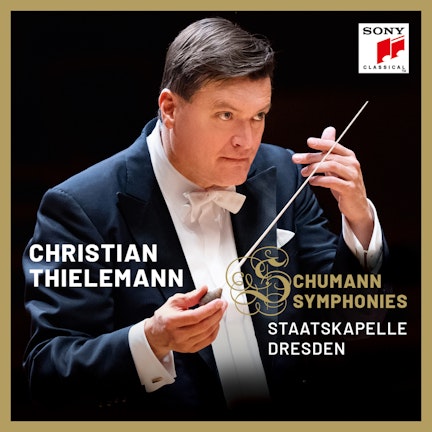
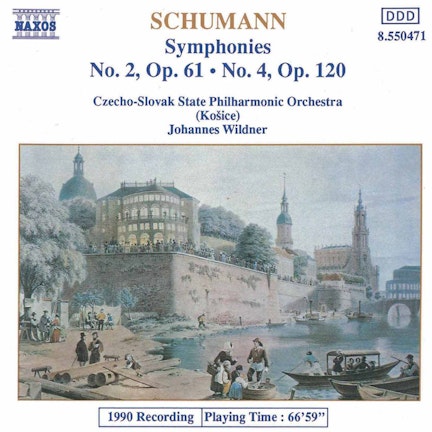
Schumann composed his Symphony No. 2 in C Major while ill with severe depression and anxiety in December 1845, stating that one could likely hear this 'dark period' in the music.
Compositional Technique
Schumann's Symphony No. 4, though formally a four-movement work, is overlaid with the idea of a 'symphony in one movement', with movements linked by transitions to form an organic whole without pauses.
Composition History
Schumann experienced composing his First Symphony in 1841 as a compositional liberation, marking a new phase in his life after focusing mainly on piano music and songs.
Compositional Technique
The finale of Schumann's C Major Symphony incorporates a quotation from Beethoven's song cycle 'An die ferne Geliebte' (To the Distant Beloved) to bring the work to a joyous close.
Compositional Technique
Schumann's Symphony No. 3, 'Rhenish', is a five-movement work where the interval of a fourth serves as the basic motivic substance, and the tempo development is directed towards the finale.
Composer's Artistic Vision
Robert Schumann, like other composers of his generation such as Franz Schubert, Felix Mendelssohn Bartholdy, and Niels Gade, aimed to develop new expressive dimensions in the symphony.
Compositional Technique
Schumann's First Symphony, nicknamed 'Spring', originally had programmatic movement headings like 'Beginning of Spring' and 'Full Spring', but the composer removed them, wishing only to 'evoke' the springtime urge.
You might also enjoy...
Schumann: The 4 Symphonies - Sony Classical Masters