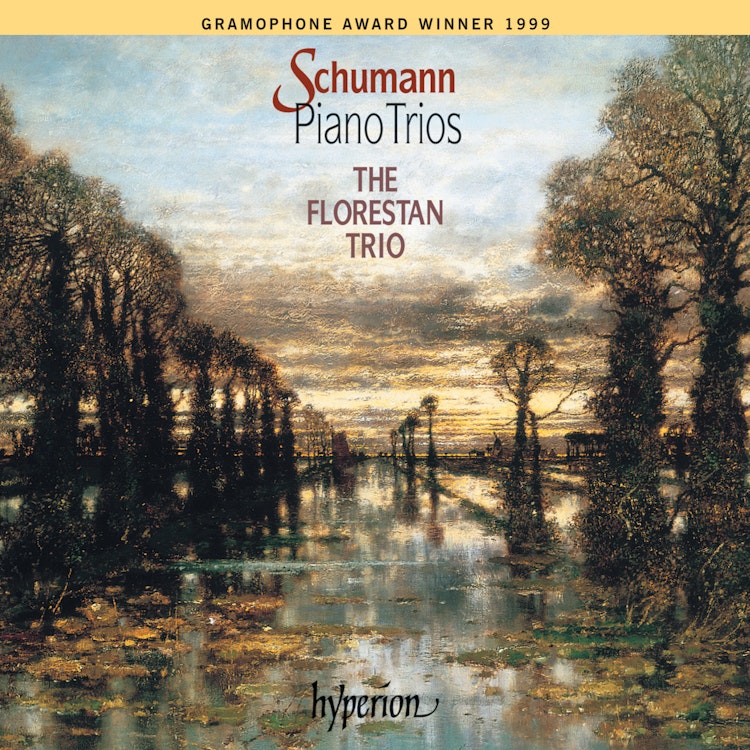
Robert Schumann composed most of his large-scale chamber works, including his three string quartets, the Piano Quintet, Op 44, and the Piano Quartet, Op 47, in the single year 1842.
Composition History
One stimulus for Schumann to return to chamber music in 1847 was his wife Clara Schumann's recent completion of her own Piano Trio in G minor.
Composer's Artistic Vision
Schumann believed the best fugue was one where the artistic roots were covered, like a flower, so only the blossom is perceived, a principle applicable to the 'artless counterpoint' in his slow movement.
Composition History
The two piano trios, Op 63 and Op 80, were composed in rapid succession in the summer and autumn of 1847, after a five-year gap in Schumann's chamber music output.
Performer Biography
The Florestan Trio, the performers on this album, received the Royal Philharmonic Society's award for chamber music in 2000, recognizing their fifteen years of dedicated ensemble playing.
Compositional Technique
The intricate part-writing of Schumann's 1847 piano trios was influenced by intense contrapuntal studies he and Clara Schumann undertook in 1845, during which he composed fugues and canonic studies.
Composition History
Schumann's first piano trio work, a set of four Fantasy Pieces, Op 88, was written at the end of 1842, immediately after he noted 'Trio by Mendelssohn' in his diary.
You might also enjoy...
La Mer - French Piano Trios
Arensky: Piano Trios
Wolf-Ferrari: The Two Piano Trios
Rachmaninoff & Tchaikovsky: Piano Trios
Poul Ruders: Piano Trio (World Premiere Recording)
Persichetti: Parable 23 / Cowell: Trio in 9 Movements / Reale: Piano Trio No. 2
Pfitzner: Piano Trio in F Major, Op. 8
Schumann Piano Trios 1 & 2
Smetana & Janáček: Piano Trios
French Piano Trios - Golub Kaplan Carr Trio Performs Saint-Saëns, Debussy & Fauré