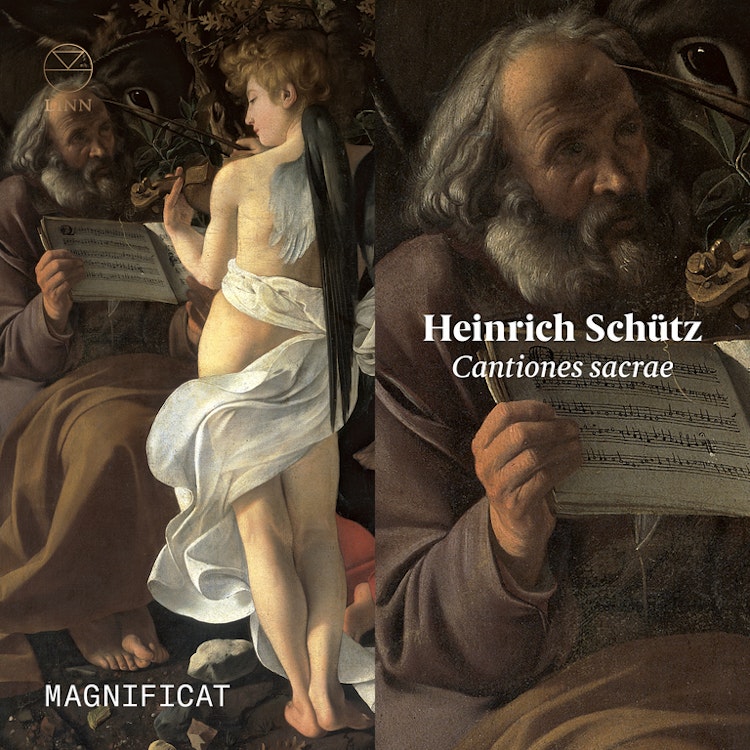
Philip Cave, the director of Magnificat, began his career as a chorister at age seven and was a founding member of The Tallis Scholars.
Historical Context
The dedication of Cantiones sacrae to Prince Johann Ulrich von Eggenberg, a Catholic Prince, by the Lutheran Heinrich Schütz, was seen as reinforcing a union between Protestant Saxony and the Habsburg Empire amidst religious and political turmoil.
Interpretation
The performers on this album use a small ensemble of singers and players, with both simple colla parte continuo playing and more flamboyant realizations, to reveal the variety of Schütz's imagination.
Compositional Technique
The Cantiones sacrae is composed in a learned, contrapuntal style rich in dissonance and range of expression, blending older and newer manners of singing.
Composer Biography
Heinrich Schütz, then a thirty-one-year-old acting director of court music, was charged with organizing all music for a high-profile visit by Habsburg royals to the Electoral Saxon Court in 1617.
Composition History
Heinrich Schütz dedicated his Cantiones sacrae to Prince Johann Ulrich von Eggenberg, a powerful advisor to the Holy Roman Emperor, despite Schütz being Lutheran and Eggenberg Catholic.
Compositional Technique
The texts for Cantiones sacrae are drawn from a 1533 prayer book compilation by Protestant reformer Andreas Musculus, featuring abstract, mystical, and intensely personal prayers suitable for both Lutheran and Catholic devotion.