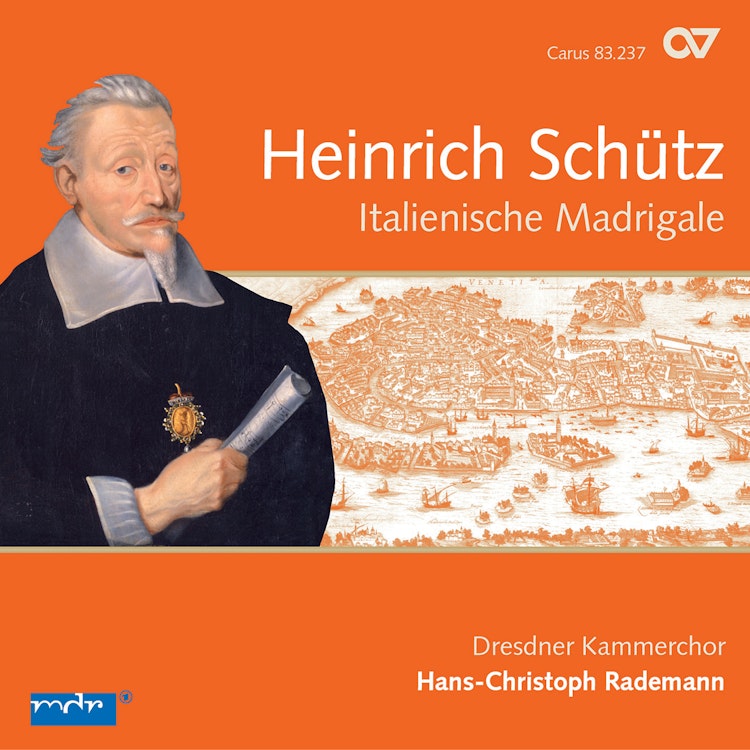
Schütz's Italian Madrigals are considered a milestone in cultural exchange between Italy and Germany and a foundational work for German composition after 1600.
Composition History
Heinrich Schütz traveled to Venice in 1609 to study with the renowned musician and composer Giovanni Gabrieli, funded by a stipend from Landgrave Moritz of Hesse.
Composition History
Schütz's 'primo libro de madrigali' (first book of madrigals) was presented to Landgrave Moritz of Hesse in 1611 as his 'apprentice work,' leading to a one-year extension of his stipend.
Performer Biography
The Dresdner Kammerchor, founded in 1985 by Hans-Christoph Rademann, is known for its intense and clear sound, and its role as an ambassador for Saxon musical treasures.
Composer's Artistic Vision
The Italian Madrigals, Schütz's Opus 1, established his artistic program and the foundation for his later German-language 'musical sermons,' focusing on blending word and music into a unified whole.
Composer Biography
Heinrich Schütz, the composer, was discovered as a boy by Landgrave Moritz of Hesse, who heard him sing in an inn and later sponsored his education.
Compositional Technique
The 19th madrigal, 'Vasto Mar,' is unique because its text was written by Schütz himself and it departs from the five-voice texture, showcasing Gabrieli's spatial music with double choirs and echo effects.
You might also enjoy...
Musica Nova - The Petrarca Madrigals
Monteverdi: Settimo Libro de Madrigali
Monteverdi, C.: Madrigals, Book 3 (Il Terzo Libro De' Madrigali, 1592)
Monteverdi, C.: Madrigals, Book 7, "Concerto" (Il Settimo Libro De Madrigali, 1619)
Monteverdi: Madrigali Libri V & VI
Prima le parole: Partitura de' madrigali a cinque voci
Robert Craft Conducts Gesualdo
Monteverdi: Madrigali libro VII
Gesualdo: Silenzio mio. Il quarto libro di madrigali