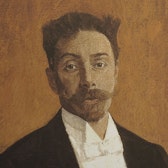
Scriabin was one of the first composers to regularly return to the sonata genre, which had been largely neglected in the second half of the 19th century.
Composer's Artistic Vision
Scriabin's Sonatas Nos. 4 and 5 reflect his philosophico-spiritual thinking and his cosmic mysticism, making him an emblematic representative of Russian symbolism.
Composer Biography
Alexander Scriabin, a classmate of Rachmaninoff at the Moscow Conservatoire, wrote exclusively for piano and orchestra, rejecting vocal music and folk elements.
Compositional Technique
Scriabin's Etude No. 3, Prestissimo, is sometimes nicknamed 'The Mosquito' due to its delicate texture of shimmering triplets in the upper register of the keyboard.
Composition History
Vers la flamme, one of Scriabin's last compositions from February 1914, is a 'post-echo' to his symphonic poem Prometheus, both using fire as a messianic vector.
Composer's Artistic Vision
Scriabin believed his magnum opus, Mysterium, a synthesis of all art forms, would trigger the end of the world if performed, but it was never finished.
Composer's Artistic Vision
Scriabin's musical language evolved from influences of Chopin and Liszt, through a Wagnerian period, to an atonal style looking towards the 20th century.
You might also enjoy...
Rachmaninoff: Piano Works
Scriabin: Vers la flamme
Back: Solo Piano Music
An Anthology of Armenian Piano Music, Vol. 3 - Composers of Armenia
Mokranjac: Complete Piano Works
Tintner: Violin Sonata / Variations On A Theme of Chopin / Piano Sonata / Trauermusik