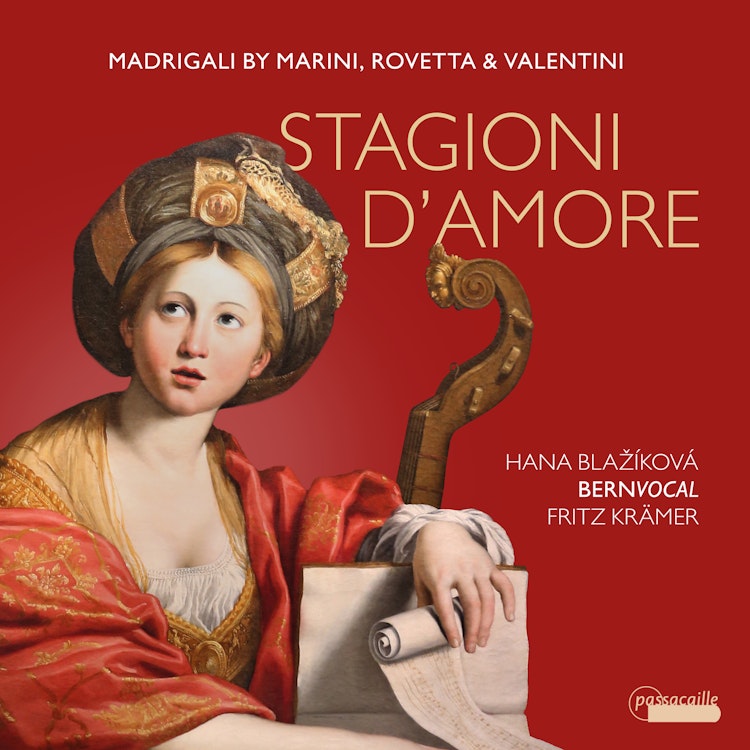
Stagioni d'amore: Madrigali by Marini, Rovetta & Valentini
10/8/2021, 17 Tracks, 1:10:50
Featuring
Hana Blažíková
Rosario Conte
Fritz Krämer
Franciska Hajdu
Anna Amstutz
Sara Gómez Yunta
Julien Léonard
Armin Bereuter
Antonio Greco
Barbora Kabátková
Jan Börner
Michael Feyfar
Markus Flaig
Raphael Höhn
BernVocal
Biagio Marini
Giovanni Rovetta
Giovanni Valentini
Did you know?
1/7
Album & Artwork
The madrigals on this album are arranged as a cycle representing the seasons of love, structured with a prologue (tracks 2-3) and an epilogue (tracks 16-17), following 17th-century theatrical tradition.
Composer Biography
Giovanni Rovetta, the third composer, had a brilliant career at San Marco in Venice, eventually becoming maestro di cappella after the death of his teacher, Claudio Monteverdi.
Composer Biography
Biagio Marini, one of the featured composers, began his career as a violinist at the renowned San Marco in Venice at just 21, where Claudio Monteverdi was the leader.
Composition History
Marini's Le Lagrime d'Erminia, his only stage work, is a paraphrase of Torquato Tasso's Gerusalemme liberata, written by the modernist Guido Casoni, a contemporary of the composer.
Historical Context
The album's theme, 'The Seasons of Love,' reflects a literary trend from the late Renaissance and early Baroque, where the contrast between nature and human emotions became increasingly complex.
Composer's Artistic Vision
The composers on this album, Biagio Marini, Giovanni Rovetta, and Giovanni Valentini, used terms like 'madrigali concertati' or 'concerti' to imply a deliberate unification of contrasting elements in their compositions.
Composer Biography
Giovanni Valentini, another composer on this album, served as an organist at the court of Sigismund III of Poland and later for Ferdinand of Habsburg (Emperor Ferdinand II) in Graz and Vienna.
You might also enjoy...
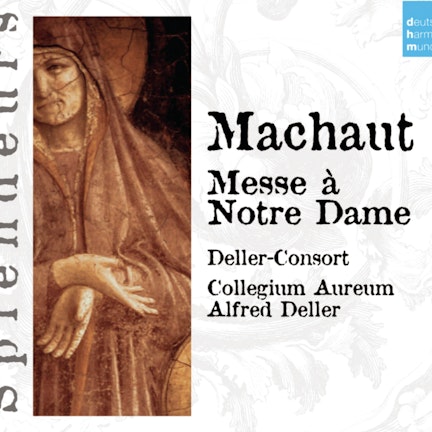
DHM Spendeurs: Machaut:Messe Nostre Dame à 4
Machaut: Messe Notre Dame
Mazzone: Il Primo libro delle canzoni a quattro voci