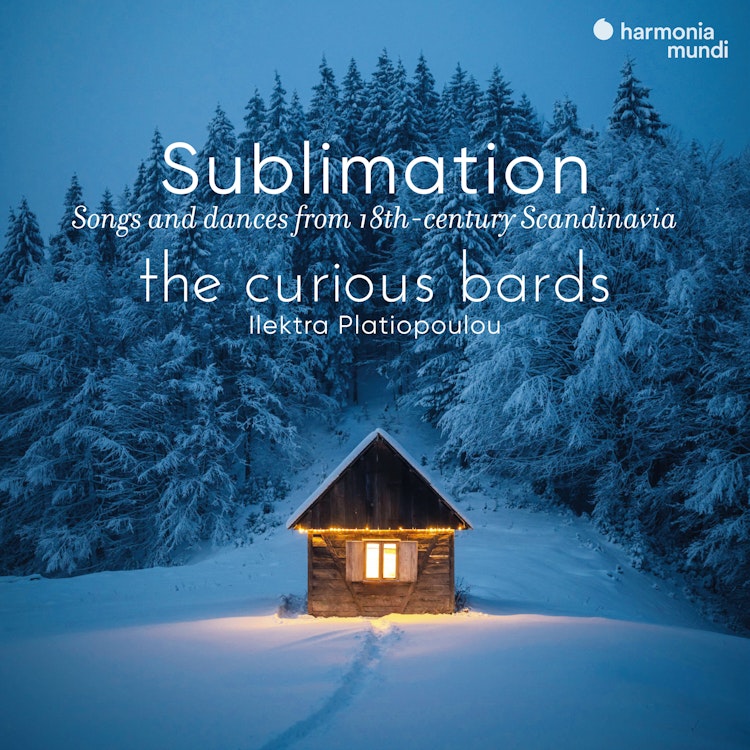
Sublimation: Songs and dances from 18th-century Scandinavia
1/24/2025, 19 Tracks, 1:04:24
Featuring
Alix Boivert
Colin Heller
Jean-Christophe Morel
Sarah van Oudenhove
Ilektra Platiopoulou
The Curious Bards
Anonymous
Anders Larsson
Erik Gustaf Geijer
Carl Michael Bellman
Did you know?
1/7
Historical Context
The 'Polonaise' dance, originating from Poland, spread to Scandinavia in the late 16th century due to geopolitical changes, such as Sweden's Sigismund Vasa becoming king of both Poland and Sweden.
Recording & Production
The Curious Bards spent four years studying the bibliography and organology of the Scandinavian Baroque repertoire to prepare for this album.
Instruments
The kontrabasharpa, an ancestor of the modern nyckelharpa, has two melody strings played by a single row of keys and typically ten sympathetic strings.
Instruments
The album features a custom-built Norwegian hardingfele (a type of violin with sympathetic strings) and a Swedish kontrabasharpa (an ancestor of the nyckelharpa), copied from 18th-century museum models.
Historical Context
In 18th-century Scandinavia, the distinction between 'high' and 'low' secular music was largely absent, with aristocracy, burghers, and peasants often sharing the same melodies.
Composer's Artistic Vision
Carl Michael Bellman, a popular 18th-century Swedish poet and composer, depicted Stockholm life and societal underbelly, and is considered an inheritor of the ballad form.
Cultural Impact
The melody of the Swedish song 'Necken' (The Merman) was later used by French composer Ambroise Thomas in Ophelia's mad scene in his 1868 opera Hamlet.
You might also enjoy...
Cantadas de pasión
Reich: Music for 18 Musicians
Liszt: Piano Works (Live)
Bravura
Per l'Orchestra di Dresda, Vol.1 Ouverture
Illogical Dance
Biber: Magno Artifitio
Pure - Works For Violin and Harpsichord By Bach, Corelli, Von Westhoff & Montanari
ITALY EP
Beethoven: Symphonies Nos. 1, 5 and 9
Merula: Musica Sacra
For Ever Fortune: Scottish Music in the 18th Century