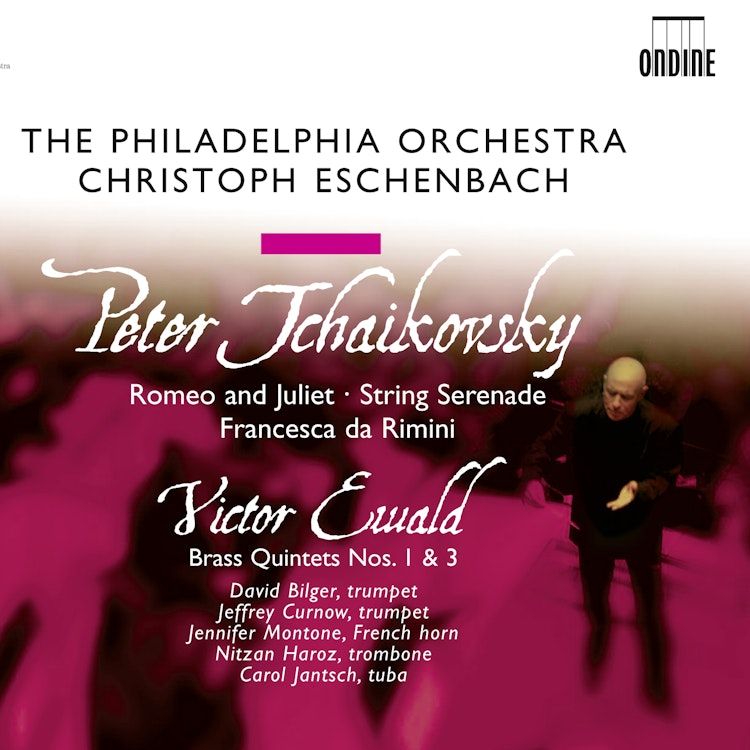
Tchaikovsky, P.I.: Romeo and Juliet / Serenade / Francesca da Rimini / Ewald, V.: Brass Quintets Nos. 1 and 3
9/30/2010, 13 Tracks, 1:53:45
Featuring
Christoph Eschenbach
David Bilger
Jeffrey Curnow
Jennifer Montone
Nitzan Haroz
Carol Jantsch
The Philadelphia Orchestra
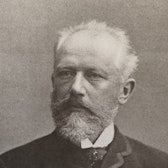
Pyotr Ilyich Tchaikovsky
Victor Evald
Did you know?
1/7
Composition History
Victor Ewald's four brass quintets, generally considered the first original works for this combination, were written between 1888 and 1912, but only one was published during his lifetime.
Critical Reception
Tchaikovsky's Romeo and Juliet initially met with little appreciation at its 1870 premiere and only found success after a major revision in 1880.
Composer Biography
Victor Ewald, composer of the brass quintets on this album, combined a career as a Professor of Civil Engineering with 16 years as the cellist of the celebrated Beliaeff Quartet, Russia's most influential string quartet at the time.
Composer's Artistic Vision
Tchaikovsky considered his Serenade for string orchestra a tribute to Mozart, whom he idolized, and wrote it from "inner compulsion" and "from the heart," unlike his 1812 Overture.
Performer Biography
Carol Jantsch, Principal Tuba of The Philadelphia Orchestra, became the first female tuba player in a major symphony orchestra when she won the position in 2006 while still a university senior.
Composition History
Tchaikovsky's Fantasy-Overture Romeo and Juliet was inspired by Shakespeare's play, with initial suggestions and a scenario provided by Balakirev, a leader of the Russian nationalist composers.
Performer Biography
Christoph Eschenbach, the conductor on this album, was mentored by both George Szell and Herbert von Karajan, crediting Karajan with a tremendous influence on his development as a conductor.