The Welte-Mignon system fell into disuse and production stopped in 1932 due to the economic crisis, improved records, and radio, with many instruments later scrapped or destroyed in WWII.
Compositional Technique
Welte piano rolls store a pianist's playing in a 'digital form' (hole - no hole), including details of rhythm, dynamics, and pedal operation, using 80 or 88 control tracks.
Instruments
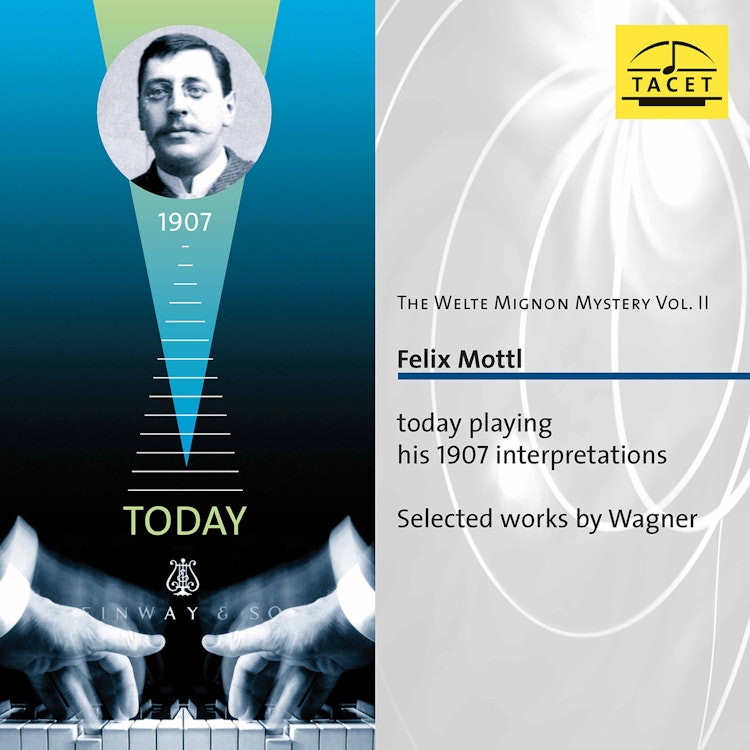
The Welte-Mignon is a player piano system invented in 1904 that could record and reproduce the nuances of pianists' performances using perforated paper strips.
Interpretation
Felix Mottl's interpretations, as captured on these piano rolls, reflect the influence of Cosima Wagner, Richard Wagner's widow, who often instructed conductors to keep orchestral volume down and favored very slow tempi.
Historical Context
The Welte-Mignon system was hailed as a 'new wonder of the world' and was found in music salons of the aristocracy, nobility, industrialists, and even on fast steamships.
Performer Biography
Felix Mottl, the conductor whose interpretations are featured, was a pupil of Anton Bruckner and served as a musical assistant at the first Bayreuth Festival performance of Wagner's 'Ring des Nibelungen'.
Recording & Production
This recording is not historical; it uses modern techniques to reproduce original interpretations from the Welte-Mignon system on a modern Steinway piano.
You might also enjoy...
Gabriel Fauré: Barcarolles, Thèmes & variations
Fauré: Les treize barcarolles
Antoni Kątski: Meditations
Sibelius: Piano Pieces Without Opus Numbers
Dvořák: 8 Humoresques, Op. 101, B. 187: No. 7 Poco Lento e grazioso
Margaret Ruthven Lang: Twilight
Brahms: Transcriptions for Piano
Pavane in F-Sharp Minor, Op. 50
Fauré: Barcarolle No. 1 in A Minor, Op. 26
Delibes: Lakmé: Flower Duet (Arr. Naoumoff for Piano)
Dvořák: 8 Humoresques, Op. 101, B. 187: No. 3, Poco Andante e molto cantabile