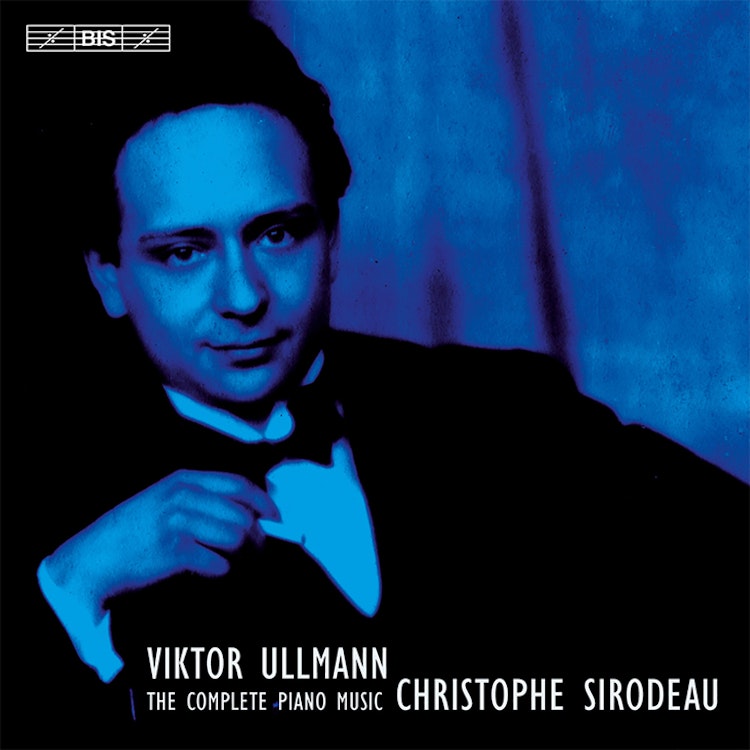
Ullmann's international breakthrough as a composer came in 1929 with his 'Variations and Double Fugue on a Small Piece by Schoenberg' at the International Society for Contemporary Music's Geneva Festival.
Historical Context
Ullmann was deported to the Theresienstadt concentration camp in 1942, where he continued to compose and organize cultural activities, stating that the camp encouraged rather than inhibited his musical work.
Composer Biography
Ullmann studied with Arnold Schoenberg, a renowned Austrian composer and theorist, and later worked as an assistant conductor for Alexander Zemlinsky, an Austrian composer and conductor, in Prague.
Composer Biography
In 1931, Ullmann, described as a 'philosophical composer,' temporarily ceased musical activities to manage an anthroposophical bookshop in Stuttgart, a venture that ended in bankruptcy.
Composer's Artistic Vision
Ullmann's piano sonatas, written in his maturity, blend traditional tonality with Schoenberg's methods, creating a unique style that also incorporates elements reminiscent of Alexander Zemlinsky and Alban Berg, both Austrian composers.
Compositional Technique
Ullmann's compositional approach often involved using the upper series of natural harmonics, creating a new scale (C, D, E, F sharp, G, A, B flat) that features prominent use of fourth intervals and the whole-tone scale.
Composer Biography
Viktor Ullmann was born in the Austro-Hungarian empire in 1898 and studied law at the University of Vienna before joining the army in 1916.
You might also enjoy...
Carl Vine: Complete Piano Sonatas
Prokofiev, S.: Piano Sonatas Nos. 1-3 / Visions Fugitives
Taubert: Piano Sonatas
Santoro: Complete Piano Sonatas
Medtner: Complete Piano Sonatas, Vol. 2
Andrzej Nikodemowicz: Piano Sonatas /Keska-piano
American Classics: Piano Sonatas Vol.2
American Piano Sonatas, Vol. 2: Griffes, Sessions & Ives