Carl Maria von Weber was particularly fond of wind instruments and wrote two concertos, a concertino, and other chamber works for his friend, the virtuoso clarinettist Heinrich Joseph Bärmann.
Recording & Production
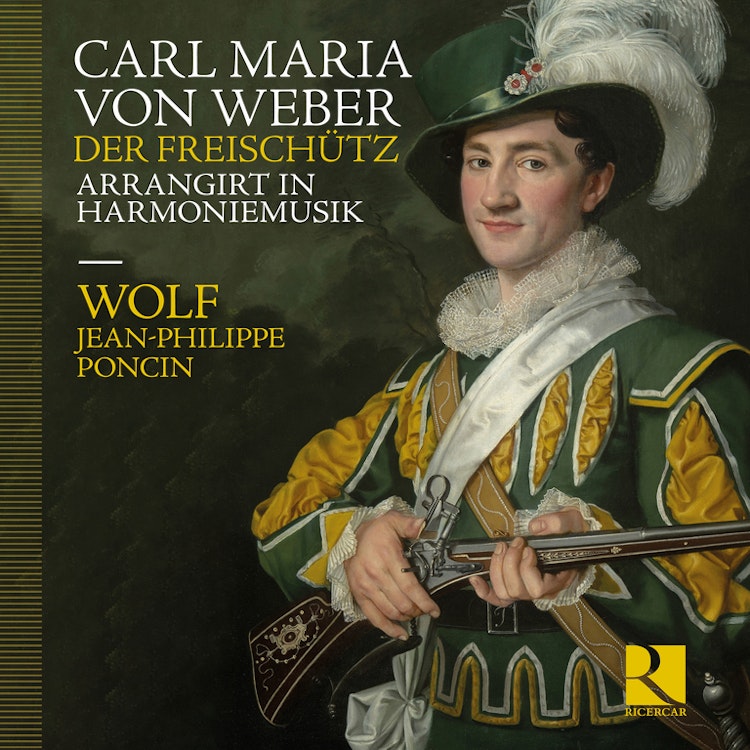
The WOLF ensemble undertook a reconstruction of Karl Flachs's 1822 arrangement of Der Freischütz, correcting errors and omissions by consulting Weber's autograph score, as previous recordings had found the overture "impossible".
Historical Context
This album celebrates Carl Maria von Weber, a composer who played a fundamental role in the development of German Romanticism, marking the bicentenary of his death in 2026.
Composer's Artistic Vision
Carl Maria von Weber played a key role in the field of opera, with his modern views on managing opera houses and the originality of his compositions, which opened doors to a new operatic language, influencing Richard Wagner.
Composition History
Transcribing opera excerpts for various instrumental ensembles was a common practice since the time of Mozart and Haydn, with the wind octet (two oboes, two clarinets, two horns, two bassoons, sometimes with a double bass) becoming a standard.
Critical Reception
Carl Maria von Weber's opera Der Freischütz was immensely successful from its 1821 premiere in Berlin, with performances quickly following in London (1824) and New York (1825).
Compositional Technique
Karl Flachs's 1825 arrangement of Der Freischütz for wind instruments adds a flute to the classical wind octet, and he skillfully distributed the rich orchestral textures, including vocal lines, among his nine instruments.
You might also enjoy...
Geoffrey Gordon: Fumée
John Williams Flute Concerto – Bernard Herrmann Souvenirs de Voyage
Czerny: Piano Music, Vol. 2
Dream Archives
J.S. Bach: Cello Suite No. 4 in E-Flat Major, BWV 1010: IV. Sarabande
Under the Ocean: Mermaid - A Cello Suite
Romanza
Nox
Say & Kerschek: Trumpet Double Concertos
Schwartz: Music for Orchestra / Music for Six Voices / Music for 12 Cellos / Music for Five Stringed Instruments
Memento
Muhly: On All Things
Andrew Downes: The Marshes of Glynn & Song of the Prairies