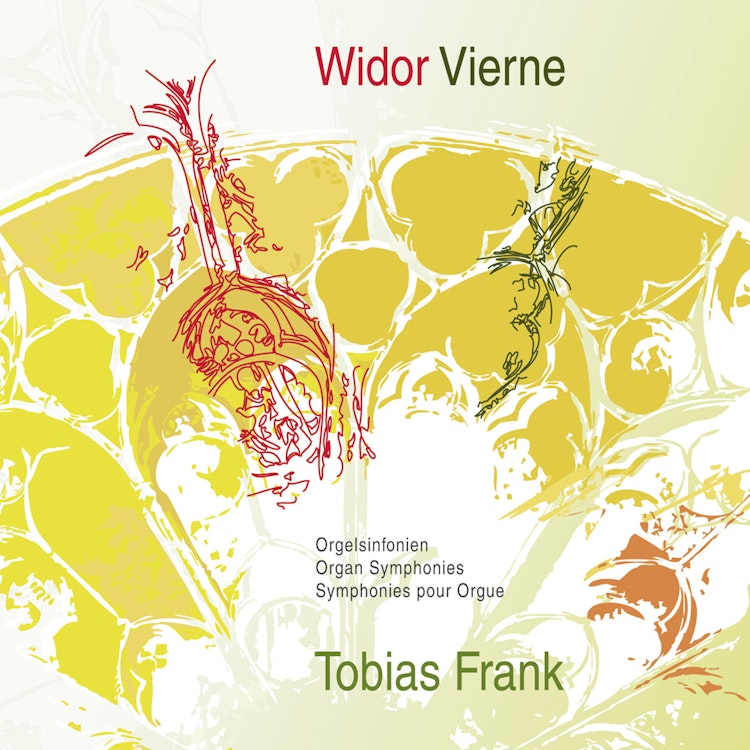
Tobias Frank, the organist on this recording, has performed in prestigious venues worldwide, including Westminster Abbey, St Paul's Cathedral, and Canterbury Cathedral.
Composer Biography
Charles-Marie Widor, a highly esteemed personality in Paris, was appointed organist at Saint-Sulpice in 1870 and remained faithful to this prestigious post his entire life.
Compositional Technique
Vierne's Symphony No. 6 features intense chromaticism at the borders of tonality and a complex thematic and motivic development, with the first movement containing the most elaborate development section in his entire oeuvre.
Composer Biography
Louis Vierne, organist at Notre-Dame Paris, faced severe hardships throughout his life, including being visually impaired from birth, relearning pedal technique after a leg fracture, and eventually becoming completely blind.
Composition History
Widor's Symphonies 5 to 8 are concert works that are considered paradigmatic of the quasi-secular 'symphony concert at the organ'.
Composition History
Vierne composed his Symphony No. 6 in 1930 in Menton on the Cote d'Azur, inspired by the sea and the Mediterranean atmosphere, and dedicated it posthumously to his friend, Canadian organist Lynnwood Farnam.
Compositional Technique
Widor's Toccata from Symphony No. 5 is the most famous movement in French organ music, influencing an entire genre with its combination of staccato manuals and a majestic pedal theme.
You might also enjoy...
Widor & Alain: Works for Organ
American Classic Widor, Vol. 1
Dupre: Antiphons, Op. 18 - Eben: Sunday Music
Widor: Complete Organ Works Vol. 4
Widor: The Organ Symphonies Vol. 4
Widor: Organ Symphonies, Vol. 3
American Classic Widor, Vol. 3
Virtuose Orgel
Widor, Vierne: The Organ Symphony
Charles-Marie Widor: Solo Organ Works
Boëllmann: Fantaisie - Heures Mystiques - Suite Gothique & Offertoire sur des Noëls
Priory LP Archive Series, Vol. 5: Music on the Organ of Truro Cathedral