Fritz Ruf, a solo violist, owned a wonderfully sonorous viola that was conspicuously black because it had been painstakingly restored after an accident, with its many scars concealed by an almost black varnish.
Recording & Production
Early digital recordings by MDG involved copying to analog tape for editing with scissors and adhesive tape, then repeating the cuts on expensive digital equipment rented for day and night shifts.
Recording & Production
The recording of the String Quintet Op. 24 presented a unique challenge because the cellist, Friedrich Kleinknecht, used a German motorists' association (ADAC) magazine with the first violin part glued in as a substitute for the full score.
Historical Context
Wolf-Ferrari, who identified as both German and Italian, was deeply affected by World War I, stating that the conflict between his 'two homelands' paralyzed him creatively.
Composition History
Wolf-Ferrari's operas were among the most popular and frequently performed works in the decade before World War I, but his success abruptly ended with the war's outbreak in 1914.
Composer Biography
Ermanno Wolf-Ferrari, born Herrmann Friedrich Wolf, was the son of a German painter and an Italian mother, and was initially expected to become a painter like his father.
Critical Reception
Wolf-Ferrari, once a celebrated master of late bel canto opera, was relegated to the 'backwater of history,' possibly due to a one-sided concept of modernity associated with Theodor W. Adorno.
You might also enjoy...
Watkins: Chamber Music and Works for String Orchestra
Brahms: Piano Trios 1-3, Clarinet Trio & Horn Trio
Moto eterno
Firebrand
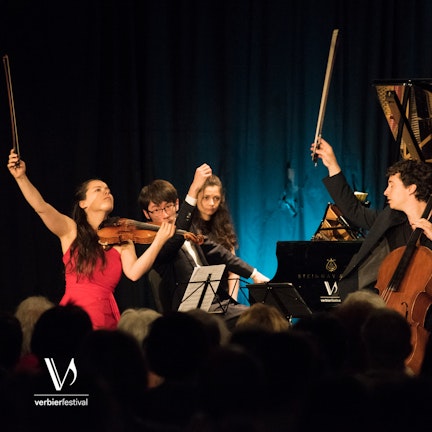
Exclusive: Verbier Festival Academy 2018 - Chamber Music 1
Shostakovich : Piano Trios 1 & 2, 7 Romances on Verses by Alexander Blok
Dvorak - Smetana: Piano Trios
Mayer: Piano Trios & Notturno
Shostakovich: Piano Trios & 7 Verses, Op. 127
Rachmaninoff: Trio élégiaques & Vocalise (Arr. J. Conus for Piano Trio)
Harbison: Piano Trios / Gatsby Etudes / The Violist's Notebook / 10 Micro-Waltzes