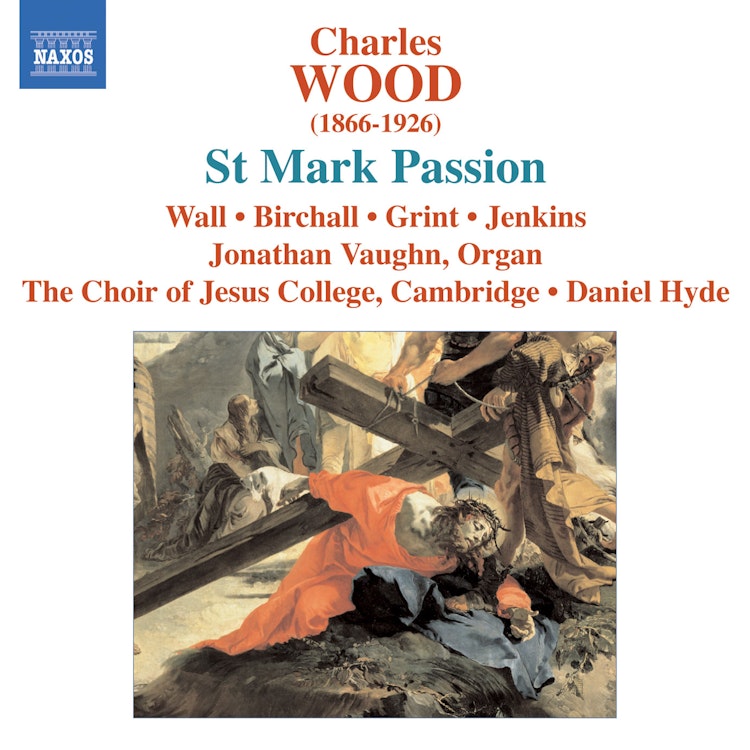
To break up the biblical narrative, Charles Wood incorporated four hymns into his St Mark Passion, including verses from 'Pange lingua gloriosa' and 'Verbum supernum prodiens'.
Composer Biography
Charles Wood, the composer of this St Mark Passion, was born in Armagh, Ireland, but made his career primarily in Cambridge, England.
Composition History
Charles Wood completed his setting of the St Mark Passion in August 1920, at the request of Eric Milner-White, the Dean of King's College, Cambridge.
Composition History
The request for Wood's St Mark Passion came after A.H. Mann, a director at King's College, concluded that Bach's Passions were too vast for an ordinary choir.
Compositional Technique
Wood's St Mark Passion includes flashes of late Wagnerian harmony alongside dry a cappella textures and contrapuntal hymn accompaniments akin to J.S. Bach's Orgelbüchlein settings.
Compositional Technique
Wood's St Mark Passion is unique among English settings of the Passion story from its time, as it uses the biblical narrative directly rather than a contemporary libretto.
Composer Biography
Charles Wood studied at the Royal College of Music in London, where his composition teachers included Stanford and Parry.
You might also enjoy...
Gounod: Requiem - Dvořák: Mass in D Major
Charles Gounod: Requiem / Antonin Dvorak: Messe in D
Faure / Durufle: Requiem
Sowerby: American Master of Sacred Song
Durufle: Complete Choral Works
Duruflé: Requiem & Messe Cum jubilo
Vierne, Alain & Langlais: Messes pour chœurs et deux orgues
Himmelborgen
Shadows on the Stars
Choral Concert: Kansas City Chorale - Spencer, W. / Corigliano, J. / Belmont, J. / Mulholland, J. / Barber, S. / Wilberg, M.