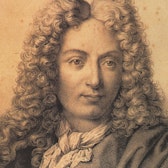
Accademia dell'Arcadia, Roma 1710: Baroque Masterpieces of a Secret Society
6/30/2015, 32 Tracks, 1:12:29
Featuring
Sabrina Frey
Fiorenza De Donatis
Andrea Rognoni
Marco Frezzato
Philippe Grisvard
Vincent Flückiger
Bret Simner
Naoki Kitaya
Alessandro Scarlatti
Ignazio Sieber
Arcangelo Corelli
Giuseppe Valentini
Giovanni Battista Bononcini
Benedetto Marcello
Did you know?
1/7
Historical Context
In the late 17th century, Italy was a battleground between the Enlightenment and the Vatican, which even led to temporary prohibitions of opera performances.
Historical Context
Queen Christina of Sweden, after abdicating and converting to Catholicism, moved to Rome in 1655, where she became a patron of the arts and commissioned works from composers like Alessandro Scarlatti and Arcangelo Corelli.
Recording & Production
Several works on this album, including pieces by Giuseppe Valentini and Giovanni Battista Bononcini, are world premiere recordings.
Composition History
The Accademia dell'Arcadia was founded in Rome in 1690 by a group of literati who were previously members of the 'Accademia Reale,' established by Queen Christina of Sweden.
Interpretation
The continuo instrumentation on this recording is full, using harpsichord, cello, theorbo, baroque guitar, violone, and organ, to achieve a rich and varied sound, as was customary in Baroque Italy.
Album & Artwork
The album title, "Accademia dell'Arcadia - Roma 1710," refers to a secret society of literati and musicians in Rome, founded in 1690.
Composer's Artistic Vision
The Accademia dell'Arcadia's emblem is a panpipe, and its artistic ideals include simplicity, moderation, beauty, elegance, and natural feelings.
You might also enjoy...
Giordani: 6 Flute Concertos
Handel: Complete Recorder Sonatas
Cauciello: Trii e duetti
Paisible: Complete Recorder Sonatas
Sammartini & Handel: Sonatas for a German Flute
Tessarini: Sei Sonate op. 14 · Il Piacier delle dame
Corelli: Recorder Sonatas, Op. 5
Prussian Blue: Flute Music at the Court of Frederick the Great
Concordi Musici
Una Follia di Napoli
18th-Century Neapolitan Flute Sonatas
Bach: Trio Sonatas
Bach: Concertos for Recorder, Vol. 2
Telemann · Fasch · C.Ph.E. Bach: Flute Concertos | Capella Clementina · Konrad Hünteler · Helmut Müller-Brühl