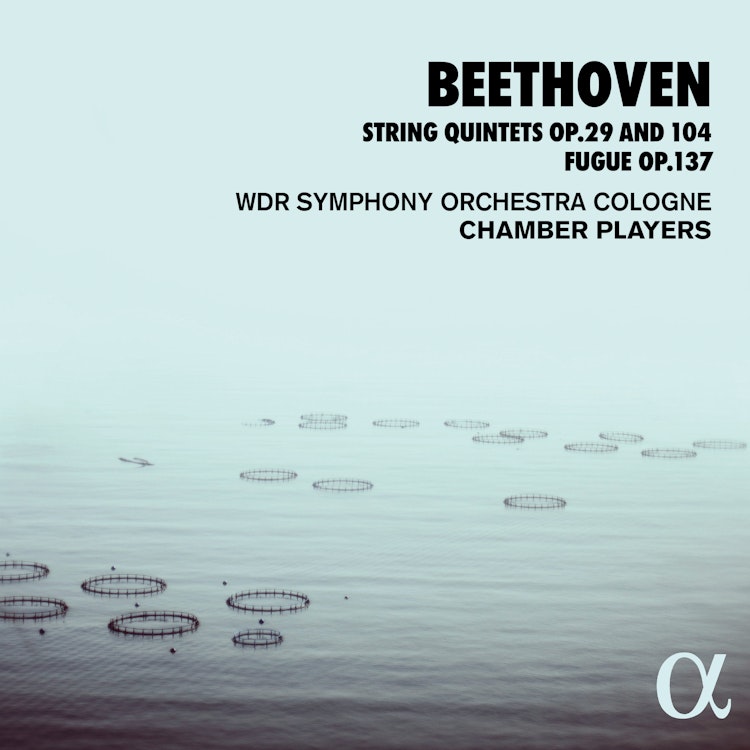
Beethoven: String Quintets Op. 29 and 104, Fugue Op. 137
1/10/2020, 9 Tracks, 1:06:12
Chamber musicians from the WDR Sinfonieorchester Köln play music that spans Beethoven's compositional career. The two String Quintets op. 29 and 104 date from 1801 and 1817 respectively, the latter a reworking of his early Piano Trio op. 1/3. The Fugue op. 137, also dating from 1817, rounds out the album in virtuosic style.
Featuring
WDR Symphony Orchestra Cologne Chamber Players
Ludwig van Beethoven
Did you know?
1/7
Composition History
Beethoven's String Quintet in C major, Op. 29, is his only work genuinely conceived for the string quintet instrumentation, composed in 1800/01.
Composition History
Beethoven humorously acknowledged the amateur arranger Joseph Kaufmann in the title of his String Quintet Op. 104, calling it 'transformed from its semblance of 5 voices to a genuinely 5-voiced work'.
Instruments
Ye Wu, a violinist with the WDR Symphony Orchestra Cologne Chamber Players, performs on a Joseph Rocca violin from 1861.
Composer's Artistic Vision
Beethoven believed that writing a fugue required imagination and a 'poetic moment' to animate the old form, rather than just special capacities.
Performer Biography
The WDR Symphony Orchestra Cologne Chamber Players, a string quintet formed in 2016 by musicians from the WDR Symphony Orchestra, received a Diapason d'or for their debut CD.
Composer Biography
Beethoven's string quintets have always been somewhat overshadowed by his string quartets, occupying a special place in his body of work.
Composition History
The String Quintet in C minor, Op. 104, has a curious origin: it is Beethoven's own arrangement of his popular early Piano Trio No. 3 in C minor, Op. 1.
You might also enjoy...
Beethoven: String Quintets, Opp. 29 & 104
Beethoven: String Quintets, Op. 4 & Op. 29
Beethoven: String Quintets, Opp. 1, 11 and 17
Boccherini: String Quintets, Op. 30 & Op.31, Vol. XI
Boccherini: String Quintets
Boccherini - String Quintets
Mendelssohn: String Quintets
Mendelssohn: String Quintets Nos. 1 & 2
Luigi Boccherini: Fandango - String Quartets
Mozart: String Quintets Nos. 2 & 4
Onslow: String Quintets, Op. 34 & 35
Mendelssohn: String Quintets
Bruckner: String Quintet in F Major, WAB 112 & Intermezzo in D Minor, WAB 113