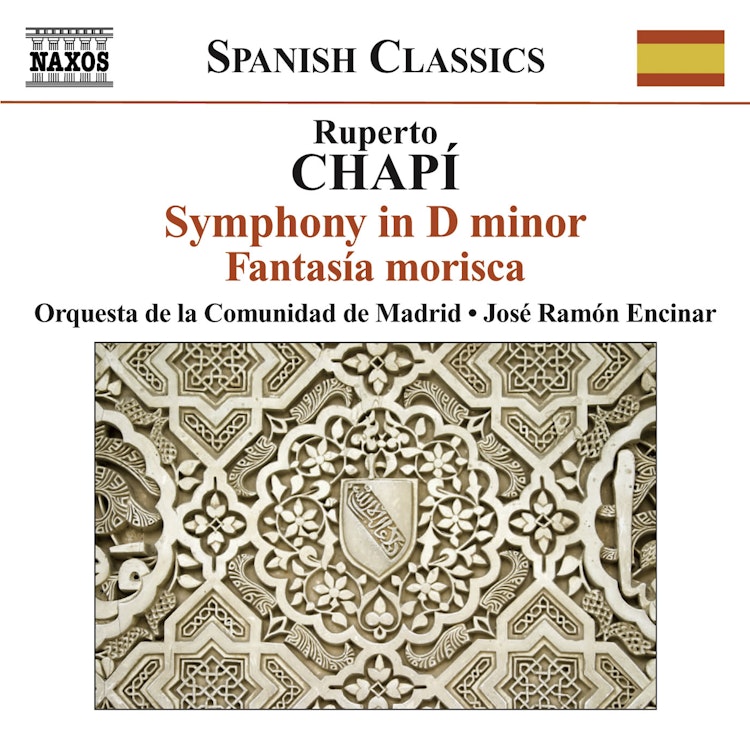
José Ramón Encinar, the conductor on this album, has led nearly all major Spanish orchestras and many abroad, and has a strong interest in 20th-century music, having directed the Koan Group for its performance.
Composer Biography
Ruperto Chapí, whose career spanned the last three decades of the 19th century, divided his time between composing and conducting, and helped establish the Spanish artists' rights association.
Composer's Artistic Vision
The Fantasía morisca reflects the 19th-century European Romantic interest in the past and the exotic, with Andalusia, Granada, and the Alhambra providing imagery that led to the aesthetic movement of 'alhambrismo'.
Composition History
Chapí successfully adapted his compositional style from zarzuela grande, a mid-1800s genre, to the later trend of shorter género chico works, which emerged due to an economic crisis.
Composition History
Chapí's Symphony in D minor was composed while he was studying at the Spanish Academy of Fine Arts in Rome and Paris, where he encountered works by Saint-Saëns, Bizet, and Massenet.
Historical Context
The Sociedad de Conciertos, which premiered Chapí's Symphony, was founded in 1866 by Barbieri to promote foreign symphonic works and encourage Spanish composers to write orchestral music in an era dominated by musical theatre and zarzuela.
Compositional Technique
Chapí incorporated elements from Andalusian music, such as the Andalusian cadence, the augmented second, and melismatic melody, into his Fantasía morisca.
You might also enjoy...
Hanson: Symphpony No. 3 - Merry Mount Suite
American Series, Vol. 3 - Still: Symphony No. 1 / Ellington: The River Suite
Aaron Copland: Symphony No. 3 & Music for a Great City
Casella: Complete Symphonies
Copland: Symphony No. 3 - Billy the Kid Suite
Richard Yardumian: Symphony No. 2 "Psalms" & Armenian Suite
Shostakovich: Symphony No. 5 / The Golden Age Suite
Weinberg: Symphony No. 12 - The Golden Key Suite No. 4
Copland: The Red Pony & Britten: Sinfonia da Requiem, Op. 20