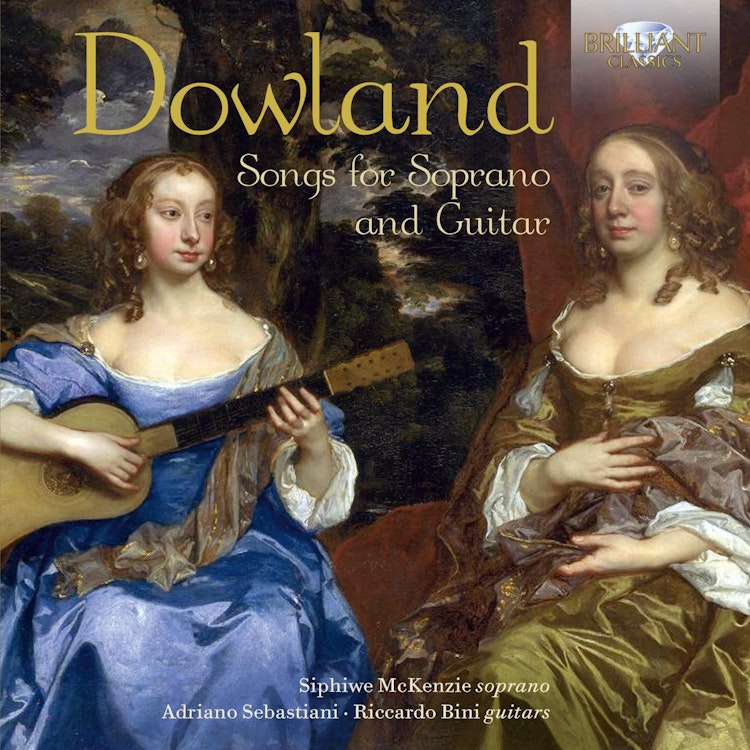
Dowland's idea to compose songs for voice and lute likely originated during his time in Paris, where he encountered Adrian Le Roy's 'Livre d'air de cours'.
Composer Biography
Dowland held a prestigious post as lutenist at the court of Christian IV of Denmark for eight years before finally securing a similar position at the English court of James I.
Composer's Artistic Vision
Dowland's songs reflect the Elizabethan age's spirit, often featuring deep melancholy and themes of night, darkness, and moonlight, though some also convey optimism and joy.
Composer Biography
John Dowland, a prominent English composer, lutenist, and singer, converted to Catholicism while working for the English Ambassador in Paris in 1580.
Cultural Impact
Dowland achieved enormous popularity during his career, evidenced by many manuscript copies of his lute works and five reprints of his 'First Booke of Songes' during his lifetime.
Instruments
The original lute pieces on this recording showcase Dowland's mastery of counterpoint, imitation, decoration, and virtuosity, faithfully transcribed from original tablatures.
Compositional Technique
Dowland's later songs, such as those in his second volume, feature more complex, non-strophic forms with demanding polyphonic lute parts that significantly contribute to the musical discourse.
You might also enjoy...
Tombeaux - Remembrances
Laudon Schuett: Dedications - New Works for the Lute
The Knight of the Lute - Music From the Varietie of Lute Lessons 1610
Reusner: Erfeuliche Lauten-Lust
Mortua dulce cano. A Florilegium of Late Renaissance Lute Music
Held, Joachim: Baroque Lute Music From the Lands of the Habsburgs