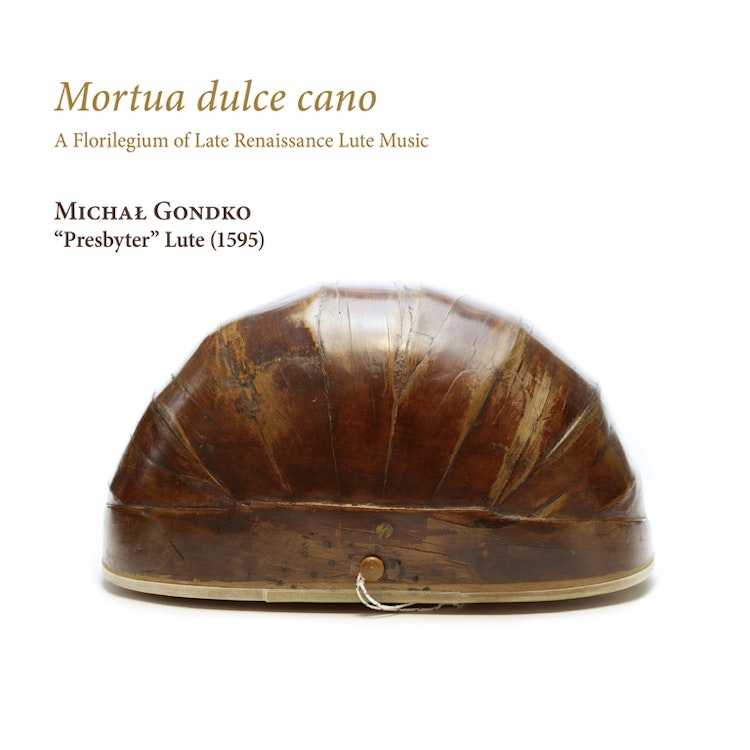
Mortua dulce cano. A Florilegium of Late Renaissance Lute Music
3/4/2022, 27 Tracks, 1:04:44
Featuring
Michał Gondko
Giulio Cesare Barbetta
Anonymous
Vincenzo Galilei
Lorenzino Tracetti
Simone Molinaro
Giovanni Battista Domenico
Kasper Sielicki
Jacob Reys
Diomedes Cato
Valentin Bakfark
Nicolas de Rans
Matthias Reymann
Johannes Spalkaiber
Benedict de Drusina
John Hoskins
Baruch Bulman
Alfonso Ferrabosco the elder
Robert Askue
John Whitfield
Did you know?
1/7
Historical Context
Padua, Italy, in 1595 was a 'lute player's paradise' due to its university attracting students, eminent lutenists, local instrument makers like Wendelin Tieffenbrucker, and lute music publications from nearby Venice.
Album & Artwork
The album title, 'Mortua dulce cano,' is Latin for 'Dead, I sing sweetly,' and refers to the lute's transformation from a living tree to a musical instrument.
Interpretation
Michał Gondko, the performer, chose to feature more obscure English lutenists of John Dowland's era, intentionally omitting Dowland's works due to the attention his oeuvre already receives.
Instruments
The 'Presbyter' lute's string tension is kept at an acceptable minimum to prevent damage to its fragile soundboard, allowing it to sing sweetly at a lower pitch than when it was new.
Recording & Production
The album was conceived and recorded by Michał Gondko during the Covid-19 pandemic lockdown, which provided an unexpected opportunity for the solo project.
Recording & Production
This recording is dedicated to the memory of Julian Bream (1933-2020) and Konrad Ragossnig (1932-2018), two influential lutenists.
Instruments
The album features an anonymous lute from 1595, known as the 'Presbyter' lute, which is one of the oldest playable lutes in existence.
You might also enjoy...
Am I Dreaming? (Contemporary Music for Baroque Lute)
The Knight of the Lute - Music From the Varietie of Lute Lessons 1610
Bach: Complete Lute Works
Tombeaux - Remembrances
Weiss, S.L.: Lute Sonatas, Vol. 7 - Nos. 15, 48
Masters of the Lute - Dowland, Kapsberger, Piccinini, de Visée & von Biber
Virtuoso Lute Music From Italy and England
Dowland: Songs for Soprano and Guitar
Lute Music From Scotland and France
Weiss
Laudon Schuett: Dedications - New Works for the Lute