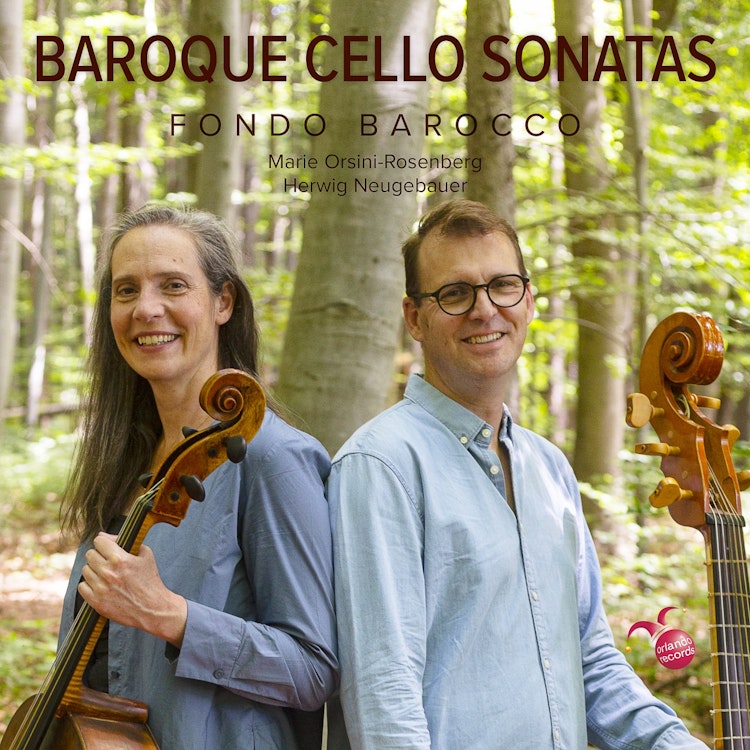
The cello became increasingly popular across Europe starting in the mid-17th century, experiencing its first peak in the first half of the 18th century as it established itself as a solo instrument.
Interpretation
The ensemble Fondo Barocco, founded in 2016, constantly expands its repertoire and sometimes swaps roles between the violoncello and G violone.
Instruments
The G violone, played by Herwig Neugebauer, is the largest 8-foot instrument, in the same register as the cello, and has frets that make it suitable for double stops and chords.
Interpretation
The ensemble Fondo Barocco performs the continuo part with only a violoncello and a G violone, a practice common in the 17th and 18th centuries to avoid transporting a harpsichord.
Composition History
Three of the composers on this album were cellists themselves, while the fourth, Giuseppe Sammartini, was an oboist.
Compositional Technique
The sonatas on this album feature varied forms, including the traditional four-movement Sonata da chiesa (slow-fast-slow-fast) and the freer Sonata da camera, which incorporates dance movements.
You might also enjoy...
Cirri: Sonatas and Duos for Cello
Il violoncello del cardinale
Albinoni: Sinfonie a cinque, Op. 2 (Alpha Collection)
Venetian Cello Sonatas. Under the Shade of Vivaldi
Defense de la basse de viole contre les entreprises du violon et les pretentions du violoncelle
Couperin: Concert Rayoux
Couperin: Concerts royaux
Telemann: Les Plaisirs de la table
Marais: Sonnerie de Sainte-Geneviève du Mont
Dietrich Buxtehude: Sonates en trio – Manuscrits d’Uppsala