Graupner's life work was inaccessible for a long time due to a dispute between the rulers of Hesse-Darmstadt and his estate, but his manuscripts are now safely stored.
Composition History
Graupner remained in Darmstadt as Hofkapellmeister until his death in 1760, having been offered a tempting salary increase by his employer.
Compositional Technique
In the Baroque era, the term 'trio' referred to three independent voices, typically two melody instruments and a continuo, not necessarily three musicians.
Composer Biography
Christoph Graupner, the composer, was born into a family of weavers and tailors in the tiny village of Hartmannsdorf bei Kirchberg in Saxony in 1683.
Composition History
Graupner, along with Telemann and J.S. Bach, applied for the post of Thomaskantor in 1722, but both Telemann and Graupner turned it down, leading to Bach's appointment.
Compositional Technique
Graupner's extensive output includes over 1,400 cantatas, around 240 orchestral works, operas, harpsichord music, and about 60 chamber music pieces.
Interpretation
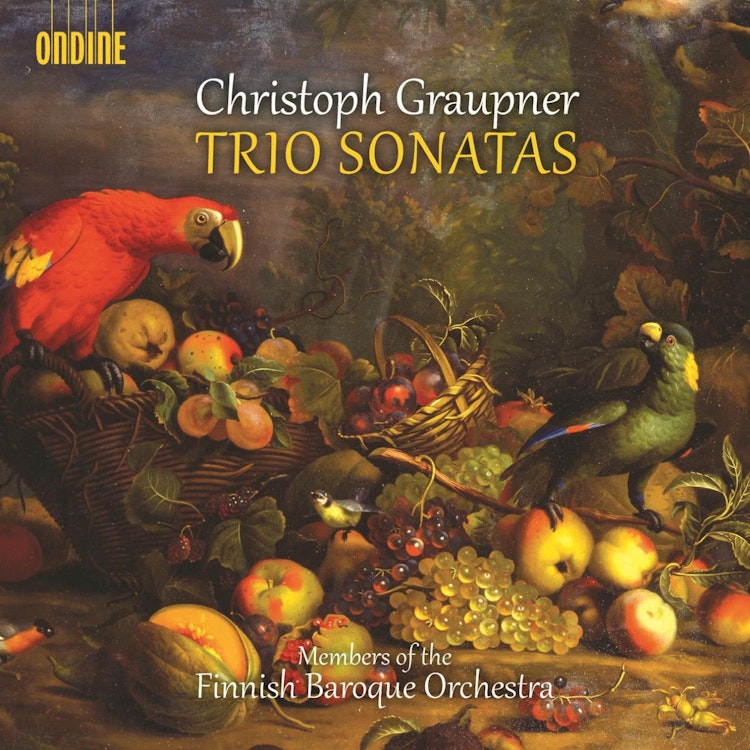
Although Graupner specified only the harpsichord as the continuo instrument in his trios, the Finnish Baroque Orchestra varies the continuo ensemble in a Baroque fashion.