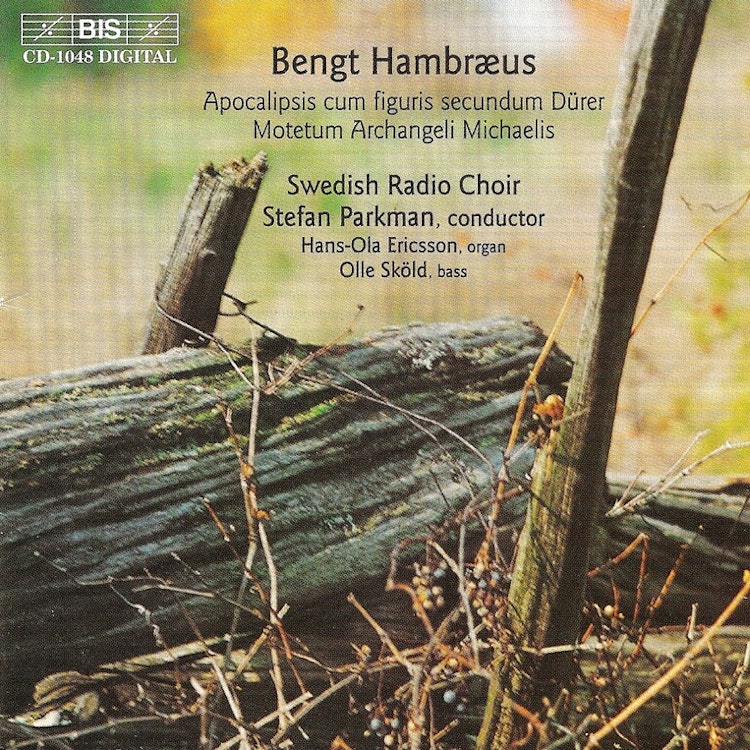
Hambraeus: Motetum Archangeli Michaelis / Apocalipsis Cum Figuris Secundum Dürer
12/31/2000, 2 Tracks, 58:06
Featuring
Hans-Ola Ericsson
Stefan Parkman
Olle Sköld
Radiokören
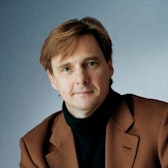
Bengt Hambraeus
Did you know?
1/7
Composer's Artistic Vision
Hambræus's later compositional period, from the late 1960s onwards, is characterized by his lifelong interest in music history and ethnomusicology.
Performer Biography
The Swedish Radio Choir, in its current form, dates back to 1952 when Eric Ericson joined as choirmaster, raising the standard of choral singing globally.
Composition History
The work "Apocalipsis cum figuris" is the final part of a large choral trilogy by Bengt Hambræus, which also includes "Constellations V" and "Symphonia Sacra."
Composition History
The work "Apocalipsis cum figuris" was commissioned for the St. Sebald Church in Nuremberg, a city significant to the composer due to its association with Albrecht Dürer and its history during WWII.
Composer's Artistic Vision
Bengt Hambræus chose Latin for the texts of his choral trilogy, viewing it as a timeless, ritual language that can be easily translated.
Composer Biography
Bengt Hambræus, the composer, had a significant impact on Swedish and Canadian musical life through his diverse roles as an organist, pedagogue, broadcaster, composer, and musicologist.
Performer Biography
Hans-Ola Ericsson, the organist on this recording, has collaborated directly with prominent composers like Olivier Messiaen, György Ligeti, John Cage, and Arvo Pärt on the interpretation of their organ compositions.
You might also enjoy...
G. Anerio: Requiem – F. Anerio: 6 Motets
Lorenzani: Motets
Haas: Das Lebensbuch Gottes, Op. 87 (Live)
Requiem: Masses by Capuana & Rubino
Spohr: Des Heilands letzte Stunden, WoO 62: Und wenn sie alle weichen, ich hange fest an dir
Gouvy: Iphigénie en Tauride, Op. 7
Bach, J.L.: Motets
Veneliti
Samuel Lampel: Abendgebet Für Schabbat (Evening Prayer for Shabbat)