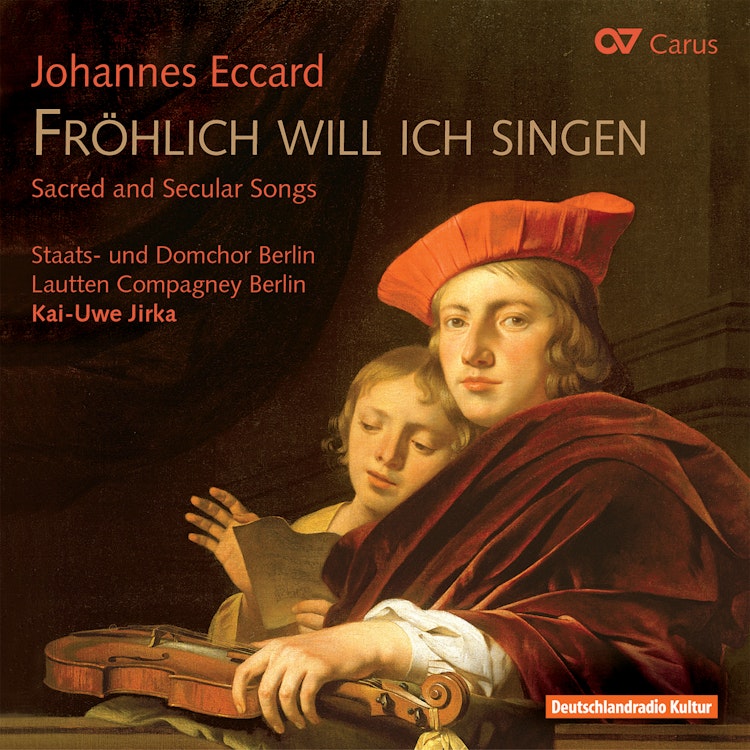
Johannes Eccard: Fröhlich will ich singen. Sacred and secular songs
10/1/2011, 18 Tracks, 58:08
Featuring
Kai-Uwe Jirka
Lautten Compagney
Staats- und Domchor Berlin
Johannes Eccard
Did you know?
1/7
Historical Context
In the 16th century, instruments like cornetts, trombones, viols, lutes, and flutes were increasingly integrated into vocal ensembles, and Eccard's sacred and secular songs were likely instrumentally accompanied.
Composer Biography
Eccard studied with Joachim a Burck (1540-1610), an organist at Divi Blasii, who introduced him to the fundamentals of musical science.
Composer Biography
Johannes Eccard (1553-1611) was born in Mühlhausen, a city that had supported the introduction of the Reformation through figures like Thomas Müntzer and Philipp Melanchton.
Composer's Artistic Vision
Eccard's artistic approach aligned with Martin Luther's requirements for church hymns, emphasizing simple, clear, and psalm-faithful expressions to engage the congregation.
Cultural Impact
Even 400 years after his death, Johannes Eccard is remembered, with his settings of hymns like Luther's 'Ein feste Burg ist unser Gott' still found in Protestant hymnals today.
Composer Biography
Eccard served as a choirboy and later an alto in the Catholic court chapel of the famous Orlando di Lasso in Munich, a period that greatly influenced his artistic development.
Compositional Technique
Eccard adopted Orlando di Lasso's 'genus mixtum'—a blend of polyphonic and homophonic writing—though Eccard's music predominantly features a chordal structure with the bass providing the harmonic foundation and the soprano leading the melody.