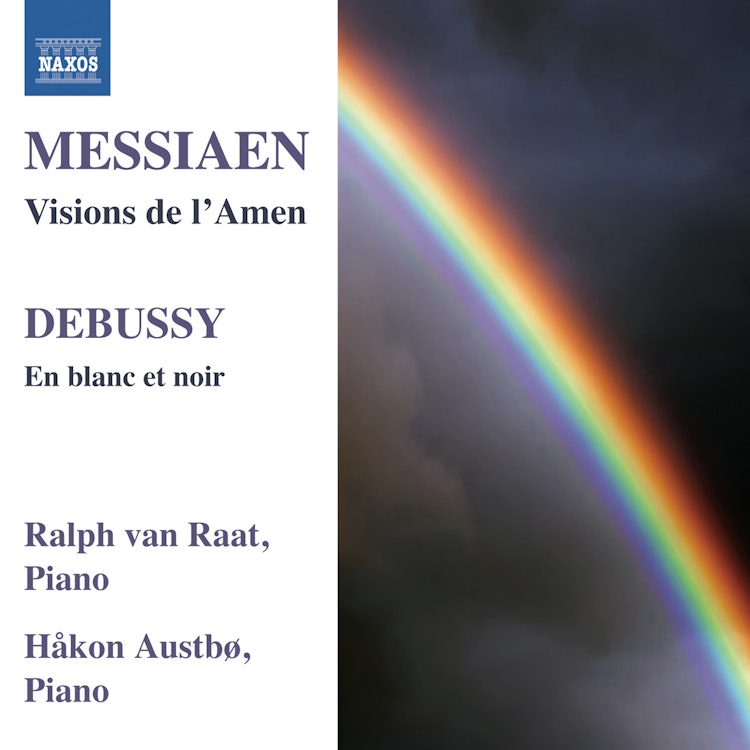
Messiaen's Visions de l'Amen uses rhythmic palindromes, or non-retrogradable rhythms, and deci-tâlas, rhythms originating from Indian tradition, which he often used as a rhythmic theme.
Performer Biography
Håkon Austbø also gained international attention in 1971 by winning the first prize of the Olivier Messiaen Competition for Contemporary Music in Royan, France.
Composer's Artistic Vision
Messiaen, from the age of twenty, explored the use of colors in music corresponding to his synesthetic color hearing, developing a system of modes with limited transposition, each with its own set of colors.
Historical Context
Both Debussy's En blanc et noir and Messiaen's Visions de l'Amen, featured on this album, were composed during wartime.
Performer Biography
Håkon Austbø, one of the pianists on this recording, was the first non-French artist to win the Concours National de la Guilde Française des Artistes Solistes in Paris in 1970.
Compositional Technique
In Messiaen's Visions de l'Amen, the roles of the two pianos are clearly divided: melodic and expressive elements are for the second piano (Messiaen's part), while percussion, brilliance, and rhythmic development are for the first piano (Yvonne Loriod's part).
Composition History
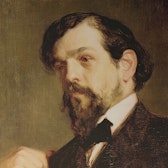
Debussy composed En blanc et noir in 1915 while struggling with his health, the horrors of World War I, and the recent loss of his mother.
You might also enjoy...
Textures
Voice
Joseph Fennimore in Concert III
H. von Herzogenberg - E. von Herzogenberg: Complete Piano Works
Debussy, Zimmermann & Strawinsky: Monolithen
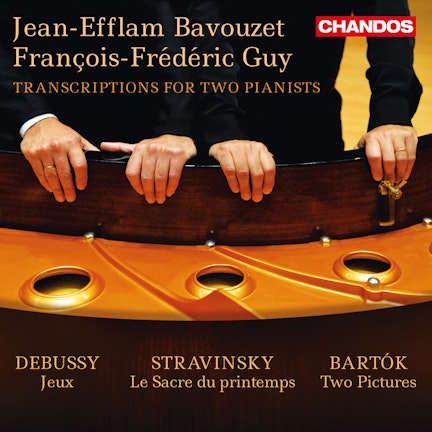
Debussy, Stravinsky & Bartók: Transcriptions for 2 Pianists
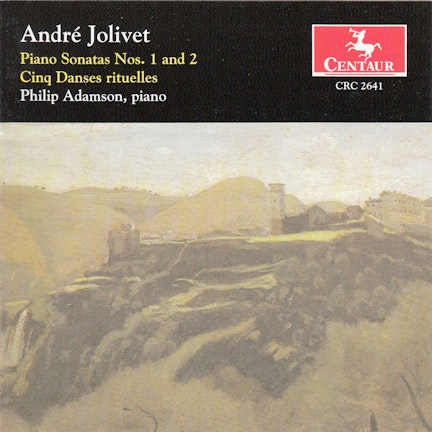
Jolivet: Piano Sonatas & 5 Danses rituelles
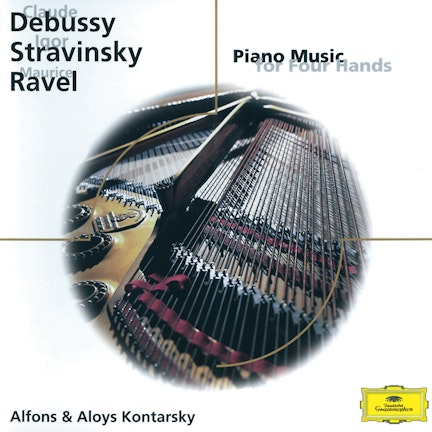
Debussy/Stravinsky/Ravel: Piano Music for Four Hands
Delius - Arrangements for Piano 4 Hands by Peter Warlock