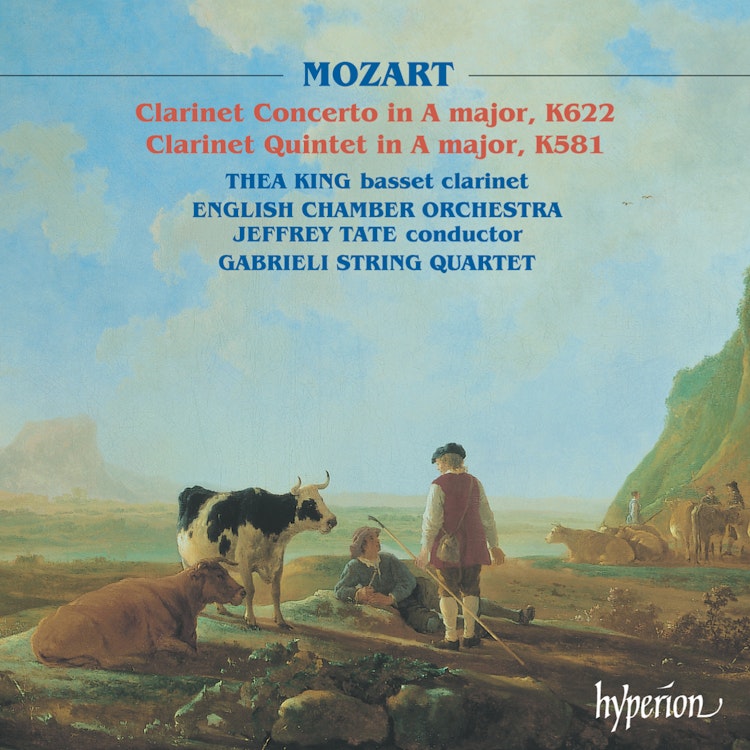
Mozart: Clarinet Concerto, K. 622 & Clarinet Quintet, K. 581
1/26/2024, 7 Tracks, 1:04:08
Featuring
Thea King
Jeffrey Tate
Brendan O'Reilly
Kenneth Sillito
Ian Jewel
Keith Harvey
English Chamber Orchestra
Gabrieli String Quartet
Wolfgang Amadeus Mozart
Did you know?
1/7
Composer Biography
Mozart's enthusiasm for the clarinet, which began in his early teens, was fully realized in the last seven years of his life through his friendship with Anton Stadler, a clarinettist of genius.
Compositional Technique
The Clarinet Concerto, written in the same year as Mozart's opera The Magic Flute, contains possible Masonic allusions, including a significant bar at number 333 and repeated use of the number three in musical figures and scoring.
Critical Reception
For nearly 150 years, performances of Mozart's Clarinet Concerto and Quintet used altered editions, until a 1967 discovery by Swiss musicologist Ernst Hess revealed how radically the original basset clarinet parts had been changed.
Composition History
The autograph scores of Mozart's Clarinet Concerto and Quintet are lost, likely given to Anton Stadler, and the basset clarinet itself became obsolete, leading to early published editions being altered.
Interpretation
This recording is the first to feature both the Clarinet Quintet and Concerto with the solo part played on a basset clarinet, using restored versions of the original scores.
Composition History
Mozart composed his Clarinet Concerto and probably his Clarinet Quintet for the extended basset clarinet, an instrument developed by Anton Stadler.
Instruments
Anton Stadler, a clarinettist and a Freemason, contributed to the technical development of the clarinet by extending its compass downwards, creating what is now called the basset clarinet.
You might also enjoy...
Mozart: Clarinet Concerto - Clarinet Quintet
Mozart: Clarinet Concerto K.622; Clarinet Quintet K.581: Classic Library Series
Mozart: Clarinet Concerto in A Major, K. 622 & Clarinet Quintet in A Major, K. 581
Mozart: Clarinet Quintet, K. 581 & Clarinet Concerto, K. 622
Mozart: Clarinet Concerto in A / Clarinet Quintet in A
Mozart: Clarinet Concerto / Clarinet Quintet in A Major
Mozart: Clarinet Concerto in A Major, K. 622 & Clarinet Quintet in A Major, K. 581
Mozart: Clarinet Concerto / Clarinet Quintet
Mozart: Clarinet Concerto & Clarinet Quintet
Mozart: Clarinet Concerto, K. 622 & Clarinet Quintet in A, K. 581
Mozart: Clarinet Concerto, K. 622 & Clarinet Quintet, K. 581
Mozart At Tanglewood
Mozart: Clarinet Concerto in A Major K.622 & Clarinet Quintet in A Major K.581 - Sony Classical Originals
Mozart: Clarinet Concerto in A Major, K. 622 & Clarinet Quintet in A Major, K. 581